
How a channel manager automates your hotel distribution
The essentials to remember: a channel manager acts as a real-time shield against overbookings by automating inventory sync across all platforms. By ditching manual updates, you reclaim hours of freedom and professionalize your distribution strategy. It is a proven growth engine, capable of boosting annual RevPAR by 18% while ensuring total operational peace of mind. 🚀
Are you tired of the manual madness of updating sites one by one and wondering if a channel manager is finally the solution to your constant fear of a soul-crushing double booking? This article explains how this software acts as your digital air traffic controller to sync rates and availability across the entire digital web in real-time. You are about to learn how to reclaim twenty hours of your week and skyrocket your total revenue using smart automation tricks that keep your property visible to global travelers 24/7 without the administrative headache. 🚀. Here you can our channel manager comparison.
- Stop the manual madness: what a channel manager actually does
- The technical engine: how data flows behind the scenes
- Moving the needle on your ADR and total revenue
- Expanding your reach across the digital map
- The future: AI and emergency inventory controls
- Making the call: is this tool worth your money?
Stop the manual madness: what a channel manager actually does
Ever spent your night toggling between browser tabs, praying you didn’t miss a booking? It is a common headache for hotel owners. But instead of fighting extranets, let’s talk about the software that acts as your distribution’s central nervous system.
Key Definition
A channel manager acts as a central dashboard to automate and synchronize availability, rates, and restrictions across all online sales channels simultaneously.
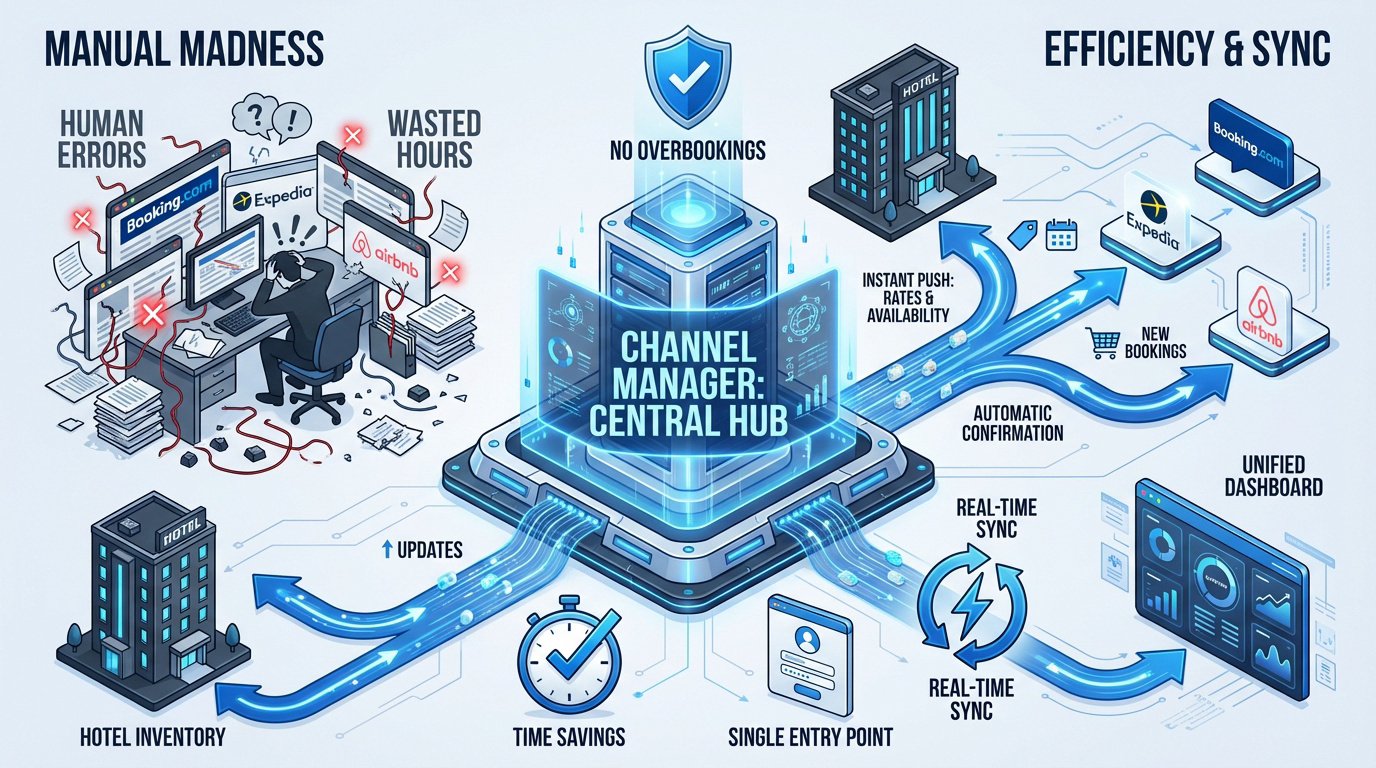
The end of manual extranet hell
Updating Expedia, Booking, and Airbnb one by one is soul-crushing. Human errors creep in when you are exhausted at 2 AM. Manual updates are a relic of the past. Why risk a bad review over a simple typo?
Think of the channel manager as your single point of entry. It pushes your rates to every corner of the web instantly. No more repetitive typing or wasted hours on clunky extranets. Bref, it just works.
- Zero manual entry
- One login for all OTAs
- Instant rate parity
- Massive time savings for staff
Real-time sync: your shield against overbookings
Double bookings are a total nightmare. Two guests snagging the last room simultaneously ruins your reputation. Plus, it costs you money in relocation fees. Faut-il miser sur la chance ? Certainement pas.
Here is how the sync works. When a room sells on one site, the software shuts it down everywhere else. This happens in milliseconds, far faster than any human could manage. It is a true game-changer.
You can finally sleep without checking your phone for new reservation alerts every hour. No more panic at midnight.
This reliability builds trust with OTA partners. They prefer properties that don’t cancel bookings due to inventory errors. It keeps your ranking high.
Centralized control for your entire inventory
The unified dashboard is your business cockpit. You see every room, every rate, and every booking in one clean view. Inventory management becomes a breeze instead of a chore. Everything is right there.
Bulk updates are life-changing. Changing prices for the whole summer takes seconds. You apply a rule once and it propagates everywhere. It is about working smarter, not harder. You stay in control.
Busy owners gain hours back. Use that time to actually talk to your guests.
Efficiency is the goal. A centralized hub is the only way to scale. Start small, but think big.
The technical engine: how data flows behind the scenes
Think of it like this: the magic isn’t just luck, but a solid technical bridge linking your hotel to the entire digital world.
Definition
Bidirectional synchronization (Two-way sync): A process where data flows both ways. Changes in the PMS are pushed to OTAs, and new bookings from OTAs are pulled into the PMS instantly via XML API.
Two-way synchronization with your PMS
Your PMS integration is a constant constant dialogue. The channel manager talks to your system non-stop. It’s a real conversation, never a boring monologue. Data flows both ways constantly.
One-way sync is a recipe for disaster. If the PMS misses an OTA booking, you’ll sell the same room twice. Bidirectional flow is mandatory to keep your sanity intact.
This connection keeps your guest list fresh. Forget about typing guest details into the PMS by hand. It is done for you automatically. Everything stays updated without any effort.
It stops the “missing reservation” nightmare. Data integrity remains rock solid. No more drama. Bref, it works perfectly every single time you receive a new booking.
From booking site to backend: the data journey
Map the journey now. A traveler clicks “book” on Expedia. The OTA fires an XML message to your manager. Then, the tool pushes that info into your database. Everything happens almost instantaneous. It’s a real game-changer for your daily operations.
Automation makes this flow seamless. Check out how the data moves through the pipes below. It happens faster than you can blink. This table shows the magic in action.
| Step | Action | Technology Used |
|---|---|---|
| Guest Reservation | Guest pays on OTA | OTA Interface |
| Data Transmission | API sends XML data | XML API |
| Inventory Update | Manager closes dates | Pooled Inventory |
| PMS Confirmation | PMS records guest info | Two-way Sync |
APIs do the heavy lifting. You just focus on welcoming your guests. No stress. It’s that simple, really.
Speed is everything in modern distribution. Don’t fall behind.
Security and compliance without the headache
Handling credit cards is a legal minefield. Don’t even think about writing numbers on paper. PCI DSS compliance is a strict requirement for any serious business today. No exceptions.
Modern managers handle virtual credit cards (VCCs) perfectly. They hide sensitive details and keep transmissions safe. You get paid without fearing a massive data breach. It’s safe.
Warning
PCI DSS compliance is mandatory for handling credit card data. Modern managers use secure transmission and mask sensitive data to prevent breaches.
Security works best when it’s invisible. Good software shields your business from cyber threats without you lifting a finger. Always. It stays quiet but strong.
Trust is your biggest asset. Secure processing means you won’t lose it over a nasty security leak. Keep it safe. Your reputation depends on it.
Moving the needle on your ADR and total revenue
Switch gears from technical logistics to the bottom line—how these tools actually put more cash in your bank account. 💸
Managing rate parity without losing your mind
Rate parity is just the rule that prices stay the same everywhere. OTAs get really annoyed if you are cheaper elsewhere. Automated parity keeps you in their good graces.
It protects your brand integrity. Guests feel cheated if they find a better price five minutes after booking. Consistency builds long-term loyalty and a professional image.
The software monitors every channel. It flags discrepancies before they become a big problem for your revenue strategy.
No more manual price checks. Let the automation handle the boring stuff for you.
Dynamic pricing and automated yield rules
Smart rules change the game. Use these triggers to grab more profit: 📈
- Increase price when occupancy hits 80%
- Lower price for last-minute gaps
- Set minimum stay for weekends
- Auto-close discount channels
Dynamic pricing reacts to the market. If a big concert is announced, your rates should jump. Smart triggers stop you from leaving money on the table during peak demand.
Yield management is for everyone. Even small properties can boost their ADR significantly.
Set your rules once. The system works while you sleep to maximize profit.
Pro Tip
Set automated triggers: increase prices by a percentage when occupancy hits 80%, or close discount channels during high-demand local events to protect your ADR.
Integration with Revenue Management Systems
An RMS is the brain, and the channel manager is the muscle. The RMS analyzes market data and tells the manager what to do. This pairing is powerful. 🧠
It gives you a competitive edge. You aren’t just guessing prices anymore. You are using data-driven insights to beat the hotel across the street every single day.
This stack is the gold standard. It turns your distribution into a high-performance engine for growth.
Professional tools yield professional results. Don’t settle for static pricing in a dynamic world.
Expanding your reach across the digital map
Now that the internal engine is humming, it is time to look outward and see how many new guests you can actually reach.
Balancing global giants with niche marketplaces
Expedia and Booking.com are the big players. Yet, they aren’t everything. Niche marketplaces often bring higher-quality guests. You really need a smart mix of global reach and local specialization to thrive today. Don’t ignore the small guys.
Check your distribution mix.
- Global OTAs for volume
- Niche sites for target demographics
- Metasearch for visibility
- GDS for corporate
This variety builds resilience.
Don’t be a slave to one platform. Bref, if they raise commissions, you need leverage. A diverse distribution strategy is your best insurance policy against platform changes.
Connecting to GDS for the corporate traveler
The Global Distribution System (GDS) is where travel agents live. It is the gatekeeper for high-value corporate bookings. These guests stay longer and spend more on services.
Connecting to GDS used to be a nightmare. A good channel manager is a real game-changer here. It opens doors to Fortune 500 travel budgets easily.
Business travelers provide a steady base. They fill your rooms during the week when leisure demand is low.
It is a professional necessity. Serious properties cannot afford to ignore the GDS.
Using analytics to ditch unprofitable channels
Not all bookings are equal. Some sites charge 25% commission while others charge 10%. Use performance analytics to see who is actually making you money after all the fees. Profitability is the goal.
Data doesn’t lie. If a channel brings lots of cancellations, cut it. Focus your inventory allocation on the partners that respect your bottom line and your time.
Be ruthless with your data. ROI is the only metric that matters.
Optimization is an ongoing process. Use the dashboard insights to refine your strategy monthly.
The future: AI and emergency inventory controls
Technology never stands still, and the next wave of distribution tools is already here, fueled by artificial intelligence.
AI-powered forecasting for smarter demand prep
Machine learning is flipping the script. AI doesn’t just look at last year. It tracks weather, local events, and flight data. Predictive analytics help you price your rooms perfectly.
It removes guesswork from demand forecasting. Anticipate busy periods weeks in advance. This allows for better staffing and efficient resource management across the property.
Stay ahead of the curve. Those who embrace AI-driven tools will dominate their local markets. The competition won’t even know why they are losing bookings to you.
Getting noticed by LLMs and AI search engines
People are booking via ChatGPT and AI assistants. These LLMs need structured data to find you. If your distribution is messy, you are invisible.
Clean data feeds are the new SEO. A channel manager ensures your property details are consistent across the web. This makes it easy for AI to recommend you.
The booking journey is evolving. You must be where the next generation of travelers is searching for their rooms.
Visibility is no longer just about Google. It is about being the top answer in an AI-driven chat.
The Kill Switch for emergency inventory control
Sometimes things go wrong. A pipe bursts or storms hit. A master kill switch is your emergency brake for the business.
One button closes all channels instantly. It prevents guests arriving at a closed property. This control is vital for peace of mind during crises.
It is a safety net you hope to never use. But when you need it, you need it now.
Total control means total confidence. Don’t leave your inventory open to chance.
Making the call: is this tool worth your money?
We have seen the tech and the future, so let’s get practical—how do you choose a channel manager and is the investment actually going to pay off?
PMS (Internal)
- Guest check-ins
- Housekeeping tasks
- Billing and invoicing
Channel Manager (External)
- OTA synchronization
- Real-time rate parity
- Global distribution reach
Channel Manager vs. PMS: clearing the confusion
Anyway, people often confuse these two. The PMS manages the internal operations like check-ins and cleaning. The channel manager handles the external distribution. You usually need both to run a modern, professional hospitality business effectively. 🏨
Some PMS systems have built-in managers. These are often basic. A standalone channel manager usually offers deeper connections and better features for serious revenue growth and global reach.
Choose based on your complexity. If you only use one site, a simple PMS might work. But if you want true growth, a dedicated distribution tool is non-negotiable.
Do small Airbnb hosts really need this?
If you have one room and one site, maybe not. But adding a second platform makes the risk of overbooking skyrocket. Manual work becomes a full-time job.
Small hosts benefit most from the time savings. Your time is expensive. Spending three hours a day on manual updates is a waste of your valuable life and energy.
No panicking: it levels the playing field. Even a tiny cottage can look as professional as a Hilton with the right tech.
Professionalism attracts better guests. They want the instant confirmation that only automated systems can provide reliably.
Breaking down costs and driving direct bookings
Pricing usually depends on your room count. A small setup might cost around €49 monthly. The ROI comes from labor hours saved and extra bookings captured through better visibility. It pays for itself quickly.
It also helps direct bookings. By keeping your site’s booking engine synced, you offer the best price and real-time availability. This encourages guests to skip the OTAs and book direct.
Think of it as a digital employee working 24/7 without mistakes. The cost-to-value ratio is usually very high.

Investing in distribution technology is investing in your freedom. It’s the only way to grow without losing your mind. 🚀
Stop battling manual updates and reclaim your freedom by automating your property’s distribution. Real-time syncing eliminates overbookings while expanding your global reach effortlessly. Implement a smart management hub now to watch your revenue soar and finally enjoy the stress-free growth you’ve earned! 🚀
FAQ
What exactly is a channel manager and why do I need one?
Think of a channel manager as the central nervous system of your hotel’s distribution. It is a powerful software that acts as a single command center, automatically syncing your room availability, rates, and restrictions across every booking site you use, like Booking.com, Expedia, and Airbnb. 🏨
Instead of wasting hours logging into ten different extranets to update a single price, you do it once in your channel manager dashboard, and it pushes that info everywhere instantly. It’s the ultimate tool to kill manual errors and win back your free time! ✨
How does the real-time synchronization actually work?
It’s all about that two-way synchronization (or bidirectional flow). When a guest snags a room on Expedia, the OTA sends an instant XML message to your channel manager. The manager then “pulls” that reservation into your system and immediately “pushes” an update to every other connected site to close that room. ⚡
This all happens in milliseconds, which is way faster than any human could ever manage. This “pooled inventory” model ensures that your live availability is always 100% accurate across the entire web, keeping your data integrity rock solid.
What is the main difference between a PMS and a channel manager?
This is a classic point of confusion! A Property Management System (PMS) is the “brain” that handles your internal daily operations—think check-ins, guest profiles, housekeeping, and billing. A channel manager is the “muscle” that handles your external sales and distribution to the world. 🤝
While they do different jobs, they are designed to work as a team. The channel manager talks to the PMS constantly to ensure your guest list is current and your front desk knows exactly who is arriving. For serious growth, you definitely want both systems integrated. 🚀
Can a channel manager really stop the nightmare of overbookings?
Absolutely! It is your best shield against the dreaded double booking. Because the software updates your inventory across all platforms simultaneously the moment a booking is made, it virtually eliminates the risk of two guests booking the same room at once. 🛡️
No more paying relocation fees or dealing with angry guests at the front desk. You can finally stop checking your phone every hour for reservation alerts and actually get some sleep knowing the system has your back. 😴
I’m a small Airbnb host—is this worth the investment?
If you only have one room on one site, you might not need it yet. But the second you list on a second platform, the risk of overbooking skyrockets! A channel manager levels the playing field, making your small rental look as professional as a Hilton with instant confirmations. 🌟
Plus, your time is expensive. Spending hours every week on manual updates is a waste of your energy. Using a dedicated tool allows you to focus on being a great host while the automation handles the boring administrative heavy lifting. ibr
Will this help me drive more direct bookings on my own website?
You bet! By integrating a direct booking engine with your channel manager, you ensure your own website always shows real-time availability and the best possible rates. This builds massive trust with your guests. 💰
When travelers see that your site is perfectly synced and offers a seamless booking experience, they are much more likely to skip the OTAs and book directly with you. This means zero commissions and more profit! 📈
What kind of ROI should I expect from this technology?
The Return on Investment is usually very high because you are saving on labor costs and capturing bookings you would have otherwise missed. In fact, properties that combine a channel manager with smart pricing tools see an average 18% boost in RevPAR! 💸
Think of the subscription fee as hiring a digital employee who works 24/7, never takes a vacation, and never makes a typo. Between the time saved and the extra visibility on global sites, the software usually pays for itself in no time. 🎯
Is my guest data safe and compliant with these systems?
Yes, and that is a huge relief! Handling credit cards on scraps of paper is a legal disaster waiting to happen. Modern channel managers are PCI DSS compliant, meaning they use secure encryption to handle sensitive payment data and virtual credit cards. 🔒
This level of security protects your business from data breaches and builds long-term trust with your guests. You get to process payments safely without the headache of managing complex security protocols yourself. Trust is your most valuable asset, so don’t leave it to chance! 🛡️