

Lodgify vs Holidu: Strategic Divide in Vacation Rental Management
In brief:
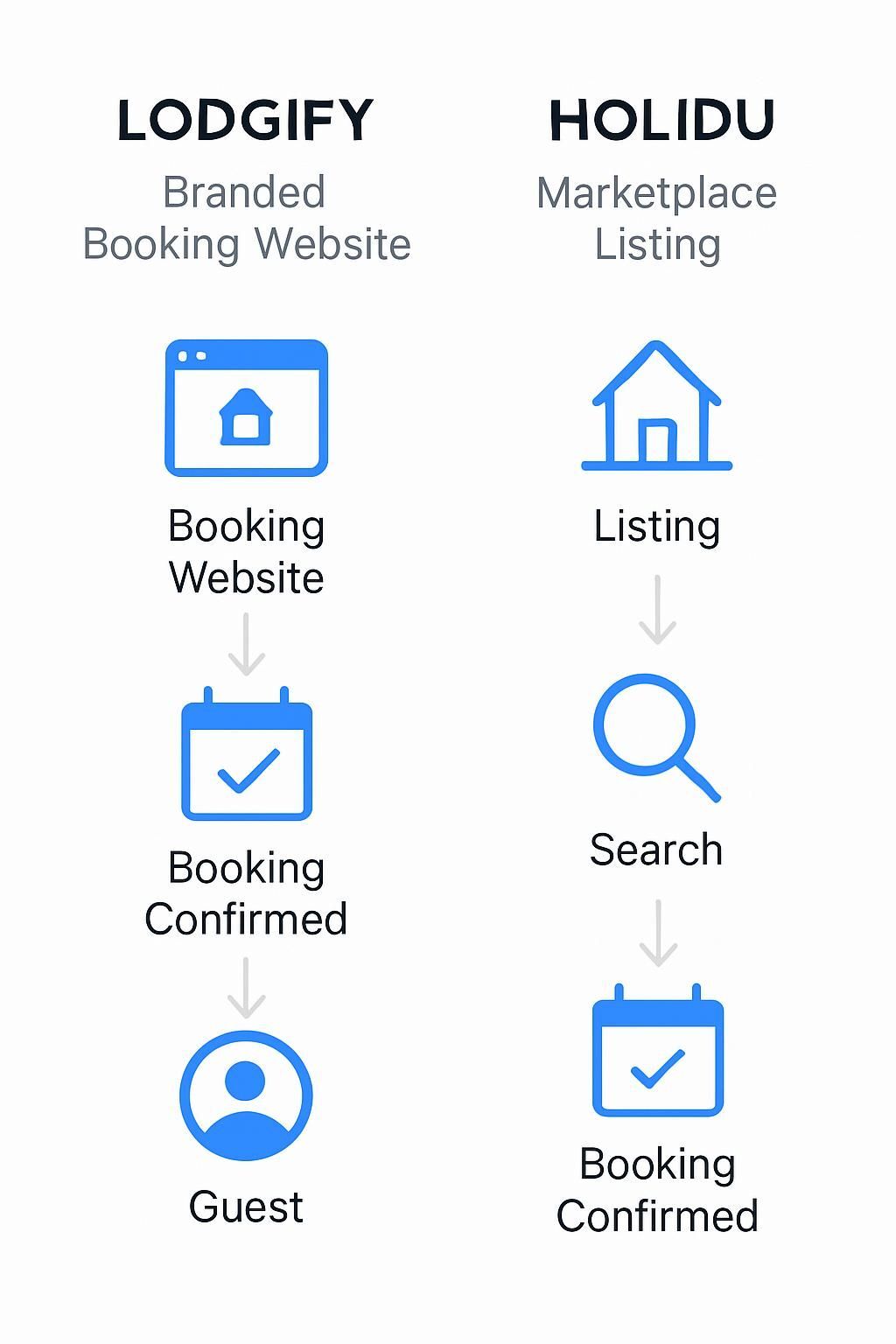
Lodgify delivers sophisticated software tools for direct bookings, flexible channel management, and advanced control—targeting owners aiming to optimize every operational aspect internally.
Holidu (powered by Bookiply) champions a managed distribution model with fixed fees and commissions, simplifying multi-channel exposure for owners who prefer operational delegation.
Cost structures differ: Lodgify’s no-commission subscription model contrasts Holidu’s commission-based platform approach affecting profit and pricing.
Connectivity: Lodgify users employ API-driven channel managers for granular control, while Holidu streamlines channel publishing with limited owner customization.
Operational workflows: Lodgify supports intricate PMS and revenue management needs, whereas Holidu delivers simplified owner portals for financial and booking overviews.
Best fit? Lodgify suits data-savvy, hands-on hosts. Holidu is ideal for owners seeking rapid listing and broad visibility with minimum intervention.
Read for side-by-side insights into cost, connectivity, onboarding, reporting, and user experiences, plus key decision checkpoints.
Renting out vacation properties in 2026 is both an opportunity and a challenge, with digital platforms shaping the way hosts manage, market, and monetize short-term rentals. Lodgify and Holidu represent two strategic poles: one puts operational command in the hands of property owners, while the other offers streamlined, managed services for those who prefer to delegate. As traveler expectations have grown and the online travel agency (OTA) landscape has become more competitive, decisions around pricing, channel selection, branding, and direct bookings can make or break profitability and guest experience. Understanding how each platform aligns with a host’s business model, technological comfort, and ambition is essential. This comparison draws on real case studies and industry feedback, guiding both ambitious vacation rental entrepreneurs and hands-off property owners toward the platform that best fits their vision and operational strengths.
Comparative Table: Lodgify vs Holidu
| Feature | Lodgify | Holidu |
|---|
Lodgify vs Holidu: Defining Core Differences in Short-Term Rental Management
Understanding Lodgify’s All-In-One Rental Software Approach
Lodgify positions itself as an all-in-one software solution built for control and growth. At its core, it brings together a powerful PMS, a flexible channel manager, a branded website builder, and a direct booking engine. This integrated ecosystem enables owners to govern every layer of distribution—syndicating listings across top OTAs while consolidating all reservations, payments, and guest communications into a single, customizable dashboard. A fictional boutique agency, “HarborLux Rentals,” illustrates this approach: able to launch a multilingual, SEO-optimized website, deploy custom pricing grids, and fine-tune distribution channels, they keep ownership of guest data and brand narrative while minimizing dependency on external marketplace rules. Advanced automation features—think triggers for messaging or calendar-driven housekeeping tasks—further streamline day-to-day operations.
For hosts with ambitions to scale and refine their property brands, Lodgify’s software suite stands out by offering full control over pricing, distribution, and customer relations, without imposing marketplace branding or restrictions on direct bookings.
Holidu’s Marketplace-Centric Model and Fully Managed Service Explained
Contrasting Lodgify’s hands-on software ethos, Holidu (with its Bookiply backbone) champions streamlined operational delegation. Here, the platform acts as both distributor and manager: owners entrust their listings and much of the operational control to Holidu’s professional on-site team. Instead of configuring granular channel strategies, hosts send over property data and content, authorize marketplace publishing, and lean on Holidu’s experience in pricing and revenue optimization. The typical owner profile? Picture “SolView Apartments”: a family-owned beach complex that wants broad distribution reach and hassle-free bookings, but has limited time or desire to master systems or nurture direct bookings. Every aspect—from setting seasonal rates to composing listing descriptions—is guided or executed by Holidu’s team, yielding simplicity for the property owner at the expense of customization and branding choices.
In this fixed-fee plus commission-based model, owners prioritize quick, visible market entry and minimal day-to-day management, with Holidu’s team ensuring listings appear across the marketplace’s whole channel network.
Target Users and Ideal Host Profiles: Lodgify vs Holidu
Lodgify’s Appeal for Multi-Property Owners Seeking Full Control
Lodgify appeals directly to entrepreneurs, agencies, and multi-property operators tied to maximizing every percentage point of margin and performance. These users thrive on the ability to enact advanced pricing rules, experiment with distribution strategies, and optimize guest qualification workflows. For instance, Lisa, who manages several city apartments in Paris, leverages Lodgify’s PMS and channel manager to sync calendars in real-time, automate guest messaging, and tailor the booking engine to reward longer stays. Her focus is on direct bookings to reduce OTA commissions, and on using website analytics to adjust marketing spend. This type of profile values sophisticated reports, detailed accounting options, and advanced integrations—everything necessary for sustained growth and operational control.
Holidu’s Value for Hosts Preferring Delegation and Simplified Management
For owners seeking to hand over the reins, Holidu delivers a compelling, hands-off alternative. Ideal users include individuals or smaller family outfits—often new to the rental business—craving frictionless access to multiple distribution channels and robust booking calendars, but wary of daily operational complexity. “SunnyBreak Villas,” for example, simply submits photographs, pricing expectations, and availability to Holidu, then lets the team calibrate market-driven rates, manage content, and pool inquiries from various OTAs. These owners appreciate the financial predictability of fixed listing fees, as well as the relief from having to monitor booking engines or analyze OTA connectivity issues. Their trust in Holidu’s managed system trades granular control for time savings and broad marketplace visibility.
Cost Structures and Profitability Impact: Subscription vs Commission
Dissecting Lodgify’s Tiered Subscription Pricing Without Booking Commissions
Lodgify employs a classic subscription approach: users pay flat monthly or annual rates in tiers, corresponding to the feature set and number of listings managed. Significantly, there are no commission fees on direct bookings—owners retain full booking revenue from their branded website, minus payment processing fees. This model particularly benefits those who channel significant sales through their own website or CRM-driven booking flows. Milestones like launching your own domain or running targeted ad campaigns to drive direct bookings are cost-neutral on Lodgify. Enhanced value comes from bundled reporting and automation features that would otherwise require piecemeal investment across separate systems.
Operators focused on optimizing margins, like the aforementioned HarborLux Rentals, see direct improvements to net earnings by keeping commissions at bay and leveraging efficient rate management tools and synced payments.
Analyzing Holidu’s Fixed Fees Plus Commission Framework and Margin Effects
Holidu integrates fixed annual or monthly listing fees with a commission-based model on bookings secured through the platform, whether sourced from its own marketplace or via OTA partners. While this approach simplifies accounting and forecasting for hosts preferring operational delegation, it introduces a variable cost directly tied to performance. On the plus side, listing activation, content publication, and initial onboarding are bundled, covering content validation and channel syndication. However, owners whose sales volume skews toward OTAs will notice diminished margin flexibility due to stacked commission charges per reservation. This is especially notable for markets driven by repeat guests or direct channels, where platform fees can erode profitability over time.
Connectivity and Channel Distribution: Custom API vs Centralized Management
Lodgify’s API-Driven Channel Manager with Real-Time Synchronization
A standout for Lodgify is its API-powered channel manager—a linchpin for properties distributed across Booking.com, Airbnb, Vrbo, and more. Real-time synchronization ensures availability, rates, and reservations update instantly across channels, minimizing the risks of double bookings and missed opportunities. The system enables granular control, letting hosts set channel-specific pricing rules or restrictions according to each partner’s demand trends. For the data-driven operator, this empowers a “surge pricing” playbook during key local events or customizing stay durations by channel. Lodgify’s unified dashboard displays live OTA connectivity health, alerting owners instantly if synchronization falters.
The end result? Confident, market-responsive distribution tightly managed by those closest to guest needs—and an unmatched ability to respond swiftly to changing market data.
Holidu’s Team-Managed Multi-Channel Publishing Limitations
In contrast, Holidu handles channel publishing centrally via its team, applying a one-size-fits-all approach to listing syndication. Owners authorize the platform to push their properties to Airbnb, Booking.com, and dozens of partner OTAs, but with limited direct input on per-channel pricing or distribution tweaks. Communication about synchronization issues or calendar mismatches routes through Holidu’s support desk, sometimes adding response lag, particularly during busy seasons. While this simplifies channel management for the hands-off owner, it also constrains flexibility: adjustments for sudden channel-specific trends or regional occupancy spikes take longer to implement, and some customization is lost.
Still, for operators less concerned with granular pricing shades and more interested in broad presence, Holidu’s managed distribution covers most major booking channels efficiently.
Direct Online Presence and Booking Workflow Differences
SEO-Optimized Website Builder and Native Booking Engine with Lodgify
A defining feature for Lodgify users is the native, SEO-friendly website builder—transforming the platform into a springboard for direct bookings and branded marketing strategies. This capability gives owners and agencies their own digital storefront, freeing them from marketplace search algorithms or commission traps. Imagine Luna, a rural retreat operator: by customizing site content, integrating blog updates, and using Lodgify’s secure booking engine, she grows organic web traffic and captures high-yield reservations. Seasonal promotions, coupon codes, and loyalty incentives—all features embedded within the Lodgify system—let hosts design and test their marketing approach, independent of OTA constraints.
This control over guest journeys and brand messaging is invaluable for those building long-term hospitality businesses, as every booking becomes a future sales opportunity.
Standardized Property Pages and Marketplace Bookings via Holidu
By contrast, Holidu positions listings within a standardized online marketplace. Property pages follow platform templates, streamlining the guest experience and maximizing cross-listing visibility across Holidu’s network. Bookings are routed through the Holidu platform, with commission and processing fees applied at every transaction. This uniformity accelerates onboarding and eliminates web development overheads for the owner, though it means sacrificing custom brand design, blog features, or advanced conversion tools. Owners like those running “SunnyBreak Villas” can access a global audience without website administration, but they cede guest contact data and most booking funnel controls to Holidu’s managed workflow.
For new entrants or those prioritizing short-term sales momentum over brand-building, Holidu’s property page architecture is a quick, effective answer.
Daily Operations & Property Management Features Compared
Lodgify’s Integrated PMS: Calendars, Payments, Messaging, Automations
A hybrid agency using Lodgify quickly benefits from the built-in PMS: unified calendar views, automated guest messaging, secure payments processing, and seamless task allocation for housekeeping or maintenance. These automation-driven workflows are exemplified by city operators like “MetraStay,” who handle 20+ apartments. Staff manage reservations, channel inventory, and stay preferences centrally while deploying automated messaging and payment reminders via the PMS. Such features are crucial for scaling, minimizing human error during busy periods, and enabling responsive guest service.
Integrated reporting, direct integration with accounting tools, and smart revenue management modules further reinforce Lodgify as a true operations hub rather than just another booking aggregator.
Owner Console and Limited Hands-Off Management with Holidu
With Holidu, property owners interact via an online dashboard—the “Owner Console”—designed to aggregate booking, payout, and performance data at a glance. Owners are spared intricate configuration but also have limited ability to select or screen guests, adjust last-minute pricing, or bulk manage reservations. The platform’s support team handles most operational adjustments, focusing the owner’s role on providing feedback and monitoring monthly sales and payout reporting. For the time-starved or tech-averse owner, this “set-and-forget” model offers predictable routines and clear, easy-to-read performance summaries. Still, the absence of custom workflows can frustrate experienced operators seeking more nuanced control or automated scaling tools.
Pricing and Revenue Management: Dynamic Strategies vs Market-Driven Recommendations
Complex Rate Configuration and Automated Pricing in Lodgify
For pricing tacticians, Lodgify offers advanced rate configuration. Property managers can set up detailed pricing rules—scheduled rate changes by season, stay length, or booking channel, and integrate with dynamic pricing partners for real-time adjustment based on demand and local events. Cabins in a ski resort, for example, deploy aggressive weekend rates and softer weekday prices to fill occupancy gaps, with Lodgify’s revenue management tools automating price shifts. This capability, together with full access to historical sales and occupancy data, means owners are never “locked in” to a one-size-fits-all pricing grid.
Holidu’s Provider-Led Rate Optimization Based on Market Data
Instead of user-driven pricing management, Holidu leans on its internal team to analyze market data and recommend (or implement) rate changes. Owners submit their preferred price bands or expectations during onboarding, but subsequent adjustments reflect a blend of algorithmic and human review—matching or outbidding rival listings across key OTAs. For “Lakeside Leisure Homes,” Holidu’s team reacts to regional events or pricing trends on behalf of the owner, but the strategy and frequency of changes are not always transparent. While this saves time and provides market-aligned pricing, it can leave detail-oriented hosts longing for more visibility and input into the revenue optimization process.
Onboarding and Support Services: Empowerment vs Delegation
Lodgify’s Step-by-Step Setup, Multilingual Help, and Integration Guidance
Initial onboarding on Lodgify is designed for rapid empowerment: step-by-step wizards, multi-language help documentation, and comprehensive integration guides ensure users can launch standalone websites, connect major OTAs, and automate core workflows with confidence. Expert support is provided via chat, email, and community forums—often cited in user feedback as a differentiator for complex property launches. For example, an agency onboarding 10 seaside rentals receives direct assistance configuring PMS modules, training staff, and importing historical reservation data. This hands-on approach ensures that even novice hosts can quickly command advanced features without excessive hand-holding.
Holidu’s Dedicated Account Management and Content Activation Workflow
The onboarding journey with Holidu begins with content submission—photos, descriptions, pricing bands—which are vetted and polished by a dedicated account manager. Listings are then optimized and published to major channels by Holidu’s on-site team, minimizing owner workload. Ongoing support revolves around monitoring performance, updating availability, and resolving channel-specific issues on the owner’s behalf. “CoveCrest Rentals,” a case study owner, attributes swift time-to-market and simplified content workflows to this model, but also notes minor friction when requesting urgent stylization updates or custom content features, as every change must go through Holidu’s pipeline.
Still, the combination of account management and hand-holding proves valuable for new and scaling owners seeking operational delegation above all.
Reporting Capabilities and Compliance Tools in Lodgify and Holidu
Customizable Financial and Performance Reporting with Lodgify
Lodgify boasts a reporting suite that covers financials, operational performance, tax compliance, and payout audits. Operators overseeing multi-owner or multi-unit scenarios can personalize dashboards—drilling into each listing’s channel performance, reservation origin, and payment status. A frequent request from property managers, cross-referenced owner statements and automated accounting reports are available for each billing cycle, supporting transparency and regulatory tracking for large portfolios. Monthly trend analysis, occupancy graphs, and transaction-level payout documentation position Lodgify as a reporting frontrunner.
Summary Sales and Payout Reports Tailored to Holidu’s Managed Model
Meanwhile, Holidu aligns its reporting strategy with a managed services mindset: owners receive digestible, summary-level reports on sales, payouts, platform commissions, and occupancy outcomes. While less detailed than Lodgify’s customizable analytics, Holidu’s simple reporting ensures owners can quickly reconcile payments and identify major distribution trends, without being overwhelmed by data. Owners focused on passive income may find these summaries sufficient, though ambitious operators looking for granular, per-channel metrics or advanced tax breakdowns may find the reporting scope lacks depth.
Feature | Lodgify | Holidu |
|---|---|---|
Pricing model | Subscription, no direct booking commission | Fixed listing fee + commission |
Channel control | Full API-driven control | Centralized, managed by team |
Reporting | Custom, detailed, exportable | Summary, sales payout-focused |
Customer support | Multilingual, documentation-rich | Account manager-led, responsive |
Branding capacity | SEO website, blog, direct bookings | Marketplace page, limited custom field |
User Feedback and Experience Insights: Control vs Simplicity
Lodgify User Praise and Challenges Due to Feature Complexity
Lodgify garners strong feedback for empowering operational oversight, transparent pricing, and OTA connectivity. Users praise the direct booking engine, sophisticated channel manager, and robust support team. However, some report an early learning curve: mastering layered dashboards, configuring automations, and deploying custom pricing grids demands time and a comfort with software complexity—especially when juggling multi-property portfolios. “After two months, I unlocked real revenue gains but had to refine our internal workflow for best use,” says one midsized property manager. The documentation and support quality ease the journey, but the high-level toolset can initially overwhelm novices. Those seeking high control find Lodgify rewarding; those requiring “out-of-the-box” simplicity may view the feature set as a double-edged sword.
Holidu Users’ Appreciation for Operational Ease and Branding Limits
By contrast, Holidu users celebrate streamlined operations and hassle-free delegation. “I wanted hands-off management and global reach; my expectations have been met,” shares a recent onboarding participant. Immediate advantages include responsive email support, timely payouts, and no need to master a full software suite. Still, user reviews highlight the trade-off: “Less direct control over pricing tweaks and branding means uniformity, sometimes at the cost of maximizing revenue.” The owner experience thrives on simplicity, but for those with bigger ambitions—custom direct booking incentives or advanced marketing—Holidu may feel restrictive.
Lodgify is best for hosts seeking to experiment with distribution strategy, build direct booking funnels, and fine-tune every touchpoint.
Holidu is suited for owners who prioritize easy management, broad channel reach, and a single-point dashboard over maximum customization.
Matching Hosts to Platforms: Business Models Best Suited for Lodgify and Holidu
Lodgify for Brands Focused on Direct Bookings and Pricing Experimentation
Hosts intent on maximizing direct booking traffic, optimizing pricing, and developing strong property brands lean toward Lodgify. Its API-driven channel manager, dynamic pricing tools, and full control over guest engagement enable constant experimentation and refinement. Case in point: Atlantic Urban Stays, a fictional chain, uses Lodgify to deploy region-specific pricing grids while funneling newsletter subscribers to their own site for exclusive offers.
Holidu for Owners Prioritizing Multi-Channel Reach with Minimal Effort
For investors or casual owners content with broad distribution, rapid listing syndication, and minimal day-to-day involvement, Holidu presents a strong proposition. Active across multiple OTAs and logistics handled by the Bookiply engine, it ensures wide visibility while keeping owner input light—at the expense of in-depth direct booking strategies and granular customization.
Real-World Use Cases: How Different Hosts Benefit from Lodgify and Holidu
Success Stories of Operational Control and Margin Gains with Lodgify
Take “Blueway Getaways,” an agency managing rural cottages and city apartments: deploying Lodgify, they consolidated 60% of annual bookings through their own website, slicing OTA-related commission expenses by a third and gaining unprecedented insight into guest behavior via reporting dashboards. Automations reduced manual tasks, freeing the team to focus on guest experience. The ability to swiftly action new pricing rules during local festivals led to tangible revenue management gains—an advantage impossible with static, manager-driven systems.
Time Savings and Simplification Advantages Illustrated via Holidu Examples
In contrast, vacation property owner Mark onboarded his two ski chalets to Holidu before the 2025 winter season. Within three weeks, listings were live across all major channels; Mark received centralized sales and payout reports and avoided configuring PMS automations—perfect, given his full-time career outside hospitality. He credits Holidu’s team for optimizing photos and descriptions, ensuring robust channel distribution and steady bookings with virtually no operational friction. For time-strapped owners, this hands-off approach is a clear asset.
Critical Pre-Decision Checks: Pricing, Policies, Sync Reliability, and Flexibility
Evaluating Pricing Governance and Cancellation Terms for Both Platforms
Hosts comparing Lodgify and Holidu must scrutinize pricing governance and cancellation policy flexibility. Lodgify enables real-time updates to website pricing, empowers custom promotional rules, and granularly configures channel-specific conditions. Holidu standardizes cancellation and pricing protocols across its network, favoring platform consistency over owner-side agility. The decision should align with a host’s appetite for control (manual, granular changes) or preference for simplicity (uniform policies, less day-to-day monitoring).
Assessing Synchronization Accuracy and Customization Limits on Direct Channels
Synchronization reliability is a non-negotiable: Lodgify’s API-based integrations seek near-instant channel updates—crucial for avoiding double bookings, especially during high demand surges. Holidu consolidates feeds via its management team; changes to rates or availability must filter through a central pipeline, which may introduce occasional lag. Customization limitations also extend to branding and guest journey aspects: Lodgify’s website builder and booking widget foster owner creativity, while Holidu constrains modification scope to maintain system-wide cohesion.
Strategic Recommendations and Next Steps for Choosing Lodgify or Holidu
Aligning Platform Choice with Host Goals and Operational Complexity
Ultimately, the best-fit platform depends on a host’s operational maturity, revenue ambitions, and appetite for complexity. Lodgify caters to hands-on hosts, budding agencies, and multi-property owners focused on direct bookings, pricing experimentation, and long-term brand building. Holidu answers the call for rapid multi-OTA distribution, predictable workflows, and owner-side simplicity, removal of day-to-day oversight, and broad, commission-based exposure.
Testing, Support Review, and End-to-End Validation to Ensure Fit
Before making a final commitment, hosts should rigorously validate chosen solutions: test onboarding flows, review documentation and support response quality, and model key booking scenarios. Assess margin impacts for both direct and OTA channels, check support scalability as listings or properties grow, and project long-term total cost of ownership.
Importance of Demo Trials and Functional Scenario Testing
Engage in full-featured demo trials: simulate a real listing launch, sync multiple channels, configure dynamic pricing, and track reporting outputs. Such hands-on trials reveal practical differences in control, ease of use, and reliability—helping hosts discover which platform aligns with their working style.
Confirming Support Responsiveness and Scalability Prospects
Prioritize reaching out to support teams for sample issues—response speed and effectiveness are key indicators of long-term platform partnership. Consider scalability: how well do reporting, synchronization, and automation resources handle portfolio expansion or increased distribution intensity?
Which platform is best for maximizing direct bookings?
Lodgify is the optimal choice for maximizing direct bookings, as it provides a customizable website builder and direct booking engine empowered by advanced channel manager functionality and comprehensive PMS features.
Does Holidu allow for granular pricing and channel control?
Holidu’s model prioritizes streamlined, managed operations and does not support channel-specific pricing tweaks or in-depth control; the Holidu team manages rates and distribution centrally on behalf of the owner.
What are the key cost differences between Lodgify and Holidu?
Lodgify employs a tiered subscription model with no commission on direct bookings, suiting owners striving for maximum margin retention. Holidu operates on a mix of fixed listing fees plus commissions, tying platform costs to booking volume and favoring low-touch owners.
How do reporting tools differ between Lodgify and Holidu?
Lodgify delivers detailed, customizable financial and performance reporting for operational optimization, while Holidu offers summary-level sales and payout dashboards focused on bottom-line clarity rather than granular data analysis.
Which is easier to set up for new property owners?
Holidu, with its fully managed onboarding led by a dedicated account manager and standardized content workflow, provides the most straightforward setup for new or time-constrained owners. Lodgify is more feature-rich and flexible, but involves a steeper initial learning curve.