

Hostaway vs Smoobu: which channel manager reigns in 2025?
In Brief
Smoobu and Hostaway are two globally recognized vacation rental software platforms for property managers with distinct strengths.
Smoobu leads with real-time API integrations to 100+ booking portals, a commission-free website builder, transparent pricing, and strong customer support.
Hostaway stands out through advanced PMS, robust automation, and in-house developed tools, but its pricing model is less transparent and requires negotiation.
Direct bookings, dynamic pricing, and mobile app usability are pivotal for modern vacation rental success, and the comparison highlights which provider excels for different business sizes.
Market reviews, trial access, support responsiveness, and integration capacity set the platforms apart for 2025 decision makers in the industry.
Global vacation rental managers in 2026 face a landscape that is simultaneously rewarding and fiercely competitive. Navigating a world dominated by giants like Airbnb, Booking.com, and Expedia, owners are also called to master direct bookings, handle complex channel management, and respond rapidly to changing guest expectations. Into this fast-moving world step Smoobu and Hostaway, two software platforms whose digital presence has been cemented across continents, trusted by both fledgling hosts and expansive property firms.
The decision to select the right vacation rental management solution often pivots on a few essential questions: Will the platform integrate seamlessly with favorite booking platforms? Does it deliver robust automation without the learning curve of a programming degree? How transparent is the pricing—and are there any unpleasant surprises lurking in the small print? Beyond flashy features, property managers seek reliability, security, and customer support they can count on for both minor inquiries and crises alike.
As digital narratives unfold on Capterra, Trustpilot, and even the social media realms of Facebook, Instagram, and LinkedIn, user reviews echo a common refrain: tools must add real value and return on investment. This investigation dives beneath the surface of Hostaway and Smoobu, scrutinizing their channel management, website builders, dynamic pricing strategies, and more—ultimately guiding property owners to a choice aligned with their portfolio’s ambitions.
Challenges in Choosing Vacation Rental Management Software: Hostaway vs Smoobu
Choosing the ideal vacation rental management software in 2026 feels like a high-stakes balancing act. Property managers must weigh automation depth, integration with global booking platforms, pricing transparency, and customer support responsiveness. Security and data privacy add another layer to the complexity, with owners looking to avoid pitfalls that can disrupt their business at peak season.
Both Hostaway and Smoobu have achieved significant global recognition, promising to address these challenges in unique ways. Yet no two property portfolios are identical—some hosts manage a handful of Airbnb apartments, while others juggle dozens of listings across diverse cities. Each solution’s core value proposition is tested by scale, adaptability, and the ability to respond to market trends such as dynamic pricing strategies, seamless integration, and real-time automation. For a property owner like the fictitious “Olivia,” who expanded from a single villa in Mallorca to a multi-location operation, reviewing these platforms’ strengths is a business-critical exercise.
Global Recognition and Usage of Hostaway and Smoobu
Across five continents, Hostaway and Smoobu are cited as industry standards for vacation rental software. Both feature on “Top 10 Channel Manager” lists and rack up thousands of verified reviews on Capterra and Trustpilot. Smoobu, launched in Berlin, has built a reputation for its streamlined user experience and multilingual support, drawing in independent hosts in Europe, Southeast Asia, and beyond. Conversely, Hostaway boasts high adoption among larger property portfolios in North America and Australia, where automation and advanced PMS are essential at scale.
Recognition alone, however, cannot solve issues property managers face daily. The spotlight falls on feature sets and real-world impact—elements at the heart of the comparison in upcoming sections. Staying relevant means understanding how each platform’s strengths map to the needs of a globalizing hospitality sector.
In-depth Channel Management Comparison: Hostaway vs Smoobu
Effective channel management is the backbone of successful operations in vacation rental. The ability to synchronize calendars, rates, and availability across dozens of platforms like Airbnb, Booking.com, and Vrbo minimizes manual work and the risk of costly double bookings. Here, Smoobu and Hostaway offer contrasting philosophies.
Smoobu’s Real-Time API Integration with 100+ Booking Portals
For vacation rental managers, Smoobu’s real-time API integration is a lifeline. Connecting to over 100 booking portals—including must-haves like Airbnb, Booking.com, and Vrbo—it automates synchronization of calendars, rates, and availability with striking efficiency. Crucially, Smoobu imposes no limits on the number of connected properties or channels on any plan, giving even the smallest hosts access to enterprise-level channel distribution without premium pricing tiers.
This direct integration ensures that a last-minute booking on Booking.com instantly updates all other calendars, eradicating overbooking scenarios. For Olivia, who manages properties in both Vienna and Bali, such cross-channel speed is vital, preventing potentially damaging guest disputes and negative reviews. The real-time nature of the API connection underpins the seamless workflow expected by modern managers who demand both accuracy and speed, especially during peak travel seasons.
Hostaway’s Two-Way Calendar Synchronization and Manual Listing Updates
Hostaway’s approach centers around a robust two-way calendar synchronization model. The Hostaway calendar acts as the “source of truth,” primarily pushing updates to Airbnb and synchronizing with platforms like Booking.com. However, new listings and updates must be manually entered into Hostaway, introducing an extra step that can challenge time-strapped managers juggling multiple properties.
Hostaway’s reliance on the user to consolidate all listing changes within its system means that, absent careful oversight, there’s greater room for error. Compared to Smoobu’s automated, API-based approach, the process feels less dynamic, particularly for property managers overseeing fast-moving portfolios or responding to frequent guest inquiries. Nevertheless, for users who value granular control and advanced filtering by property, Hostaway still presents a powerful, albeit hands-on, option.
Impact on Double Bookings and Channel Management Efficiency
Double bookings remain a looming threat for vacation rental businesses. Smoobu’s API integration, with its instantaneous synchronization, significantly diminishes this risk. Hosts managing both direct bookings and third-party channels benefit from a peace of mind that few manual syncing processes can offer.
In contrast, Hostaway’s partial reliance on manual updates opens a window—however small—for booking overlaps, especially during high season or in portfolios where multiple staff handle property management. The efficiency edge here firmly tilts towards Smoobu for diverse, multi-platform portfolios, reinforcing the growing demand for API-powered, low-risk channel management in 2026’s digital ecosystem.

Website Builder Capabilities: Smoobu’s Intuitive Platform vs Hostaway’s Limitations
In the battle for direct bookings and independence from intermediaries, a customizable, secure, and mobile-friendly website builder is no longer optional but essential. Both Smoobu and Hostaway know that creating a digital storefront under complete host control determines booking flow, guest loyalty, and ultimately, profitability.
Mobile-Friendly, Commission-Free Direct Booking with Smoobu
Smoobu offers a website builder that stands out for its balance of ease and professionalism. Integrated into every plan at no extra cost, the builder empowers hosts to launch a fully responsive site—optimized for all devices—that supports commission-free direct bookings. Within minutes, owners craft multi-lingual, secure websites, plug in booking calendars, and synchronize inventory in real time with all connected platforms.
This intuitive approach favors smaller hosts without a tech background and emerges as a powerful asset for unique properties that benefit from storytelling and brand identity—think eco-lodges in New Zealand or boutique Parisian apartments seeking to drive direct traffic away from Booking.com or Airbnb. The full integration with the channel manager means any website reservation reflects immediately in all other connected calendars, maintaining a watertight approach against double bookings and inventory mismatches.
Hostaway’s Customization Restrictions and Domain Management Challenges
On the flip side, Hostaway’s website builder faces more limitations. Customization options are fewer, with templates offering less flexibility for personal branding or advanced SEO strategies. Critically, hosts cannot configure custom domains directly within Hostaway, instead needing to manage external DNS settings—an involved process for less technical users and a potential stumbling block for rapidly growing businesses.
This disconnect can disrupt the direct booking journey, limiting marketing creativity and hampering hosts’ ability to appear polished and professional online. For properties competing in style-driven urban markets such as Berlin or Miami, the website builder’s constriction is a non-trivial constraint. As more hosts chase direct guest relationships—prompted by the risks and commissions of third-party platforms—it becomes clear that ease of use and true integration are significant competitive differentiators.
Booking Engine Features: Seamless Direct Bookings on Smoobu vs Hostaway’s Gaps
With vacation rental revenue increasingly reliant on direct bookings, the booking engine’s reliability and guest-friendliness directly shape conversion rates and guest satisfaction. Here, the differences between Smoobu and Hostaway come into sharp focus.
Smoobu’s Commission-Free Secure Booking Engine and Payment Integration
Smoobu’s booking engine, tightly coupled with its website builder, stands out for being commission-free and highly secure. Hosts can embed the engine on any external or Smoobu-designed site, all while staying synchronized with the central channel manager. Bookings flow automatically into the system—with guest data, calendar updates, and payment processing handled without extra effort.
The booking engine supports multiple payment methods, offering full support for payment gateways such as Stripe and PayPal. This flexibility ensures that guests from any continent can complete reservations with the currency and platform they trust—reducing abandoned carts and maximizing conversion rates. For a host catering to international clientele, such as the fictional “Jonas” in Cape Town, the streamlined, multilingual engine brings direct global reach that was once possible only for established hotel brands.
Hostaway’s Booking Engine Availability and Direct Booking Implementation Issues
Unlike Smoobu, Hostaway does not present a clearly mapped booking engine solution. Information for embedding direct booking capabilities onto an external site is limited, and integration is not as robust or straightforward. Users often report on Capterra that cementing true direct booking functionality involves additional development work or reliance on external developers—introducing delays and costs that deter smaller operators from capitalizing on direct booking revenue streams.
The result is a scenario in which advanced operators with development resources might succeed, but the average host faces barriers that Smoobu has effectively removed. In an age where instant gratification defines guest preferences, any friction in the direct booking flow quickly translates into lost opportunities and negative reviews. The comparison here is stark and shapes overall perceptions of real-world operability.
Dynamic Pricing Tools: Transparent Smoobu Flexibility vs Hostaway’s Pricing Barriers
Dynamic pricing is no longer reserved for hotels or airlines. For vacation rental managers eager to maximize yield, transparent and data-driven rate adjustment tools are crucial. How do Smoobu and Hostaway measure up?
Smoobu’s Data-Driven Dynamic Pricing with Free Trial Offer
Smoobu’s newly launched dynamic pricing tool is engineered for today’s data-centric era. Powered by the analysis of market demand, seasonal trends, and local events, the feature allows hosts to effortlessly automate nightly rates. A key selling point: a generous 30-day free trial, available to all plan levels, lets users assess revenue impact without upfront payment.
Pricing is competitive and straightforward—a set monthly fee per property, with transparency front and center. There are no hidden surcharges, no surprise commissions. For hosts like Olivia, testing a tool without obligation before scaling across her apartments in Vienna and Istanbul proves invaluable—especially as many competitors in the sector still gate premium features behind higher, opaque fees. This democratization of technology levels the playing field for independents and multi-property rental managers alike.
Hostaway’s Pay-Per-Listing Pricing Model Without Transparent Fees
Hostaway also advertises dynamic pricing functionality, but the details reveal hidden hurdles. Access is granted on a pay-per-listing basis, and pricing information is not readily disclosed on Hostaway’s website—requiring direct negotiation with their sales team. Moreover, there is no free trial, and dynamic adjustment often relies on third-party partners, adding to cumulative operational costs.
This lack of transparency and requirement for manual configuration contrasts with Smoobu’s self-service, straightforward approach. For cost-conscious operators and small vacation rental portfolio owners, the uncertainty surrounding Hostaway’s dynamic pricing can be a deterrent. As market competition intensifies, property managers demand not just results, but clarity and fairness in their technology investments.
Mobile Management Apps Compared: User Experience and Feature Accessibility
The rise of the always-connected host transforms the mobile app from an optional add-on to an operational necessity. Whether coordinating maintenance on-site, messaging guests in multiple time zones, or monitoring occupancy from a cafe, Smoobu and Hostaway position their mobile solutions at the forefront—but usability marks a key divergence.
Smoobu’s Highly Functional and User-Friendly Mobile App Advantages
Smoobu’s mobile app receives consistent praise on Trustpilot and Capterra for its user-friendly design, stability, and comprehensive feature set. Hosts can communicate with guests, modify rates, oversee cleaning schedules, and respond to new bookings all from within an intuitive interface. Regular updates from the Smoobu team ensure that bugs are quickly squashed and new features align with manager feedback.
Importantly, all mobile functionality is included in every subscription plan at no extra cost, breaking down financial barriers for smaller operators. The mobile app is a lifeline for managers like Jonas who handle reservations while traveling—enabling operational freedom not possible with tethered desktop systems.
Hostaway’s Feature-Rich But Less Intuitive Mobile Solution
Hostaway’s mobile app, while feature-rich and praised for breadth, is consistently rated as less intuitive compared to its web counterpart. Some users, especially those new to vacation rental software, find navigation cumbersome, which can lead to miss-clicks or workflow inefficiencies during busy periods. Updates are less frequent, and some core features are streamlined for desktop, meaning full management may require switching devices.
For complex or large portfolios, Hostaway’s depth remains unmatched—but for time-pressed, on-the-go managers, the lack of transparency in mobile feature parity is often mentioned in online reviews. The granularity offered is powerful for advanced users yet doubles as a steeper learning curve for others. This reality shapes onboarding and ongoing operational comfort across both small and enterprise-level businesses.
Customer Support, Free Trials, and Market Reputation Analysis
Vacations should mean relaxation, not troubleshooting software glitches or chasing down overdue payments. The quality and accessibility of customer support become decisive factors for vacation rental hosts, particularly those operating in time zones far from the provider’s headquarters. Here, Smoobu and Hostaway display quite different approaches to user care, trial access, and market perception.
Smoobu’s Multilingual, Responsive Support and No-Obligation Trial Access
Smoobu puts support at the heart of its offering. Its multilingual team can be reached via phone, email, or live chat, assuring quick response regardless of where a host is located. Hosts report instances—such as Olivia’s fire alarm malfunction just hours before a guest’s arrival—where real-time support prevented cancellations or prevented negative reviews.
Smoobu also invites experimentation with a 14-day free trial requiring no credit card or obligation. This period grants full access to all functionality, empowering users to make informed decisions based on real data rather than generic demos. The ability to test integrations, automation setups, and web features first-hand is critical for both tech-savvy and novice hosts looking to build confidence before investing further.
Hostaway’s Limited Support Availability and Absence of Free Trial
Hostaway, by comparison, directs users to support primarily via online tickets and email. Users note that response times can lag during European evenings or North American weekends, leading to operational delays. Reaching specialized teams—especially for advanced technical integration issues—can pose challenges for property managers with multiple listings across different geographies.
Unlike Smoobu, Hostaway does not offer a no-obligation trial; access to the platform is typically preceded by a live demo, which must be scheduled in advance. For new entrants or side-hustle hosts, this presents an additional barrier to entry. The resultant learning curve, and inability to “kick the tires,” shapes the confidence with which new customers approach the software—a recurrent theme in public feedback.
User Reviews Highlighting Pricing Transparency and Service Quality
User reviews on Trustpilot, Capterra, and mainstream social channels reveal nuanced trends: Smoobu wins for transparent billing, quick onboarding, and responsive customer support, making it especially attractive for cost-conscious hosts and those new to vacation rental management software. Positive experiences abound, including hosts celebrating seamless onboarding or immediate help during integration hiccups.
Hostaway, while favorably reviewed for its system capabilities and automation features, often receives less glowing feedback on pricing clarity and post-purchase service. Reports from users suggest a disconnect between sales promises and operational realities, primarily stemming from hidden surcharges or unclear contract terms. In the end, these user stories influence platform reputations—a fact not lost on savvy, review-savvy property managers.
Pricing Structures and Value Assessment: Smoobu’s Transparency vs Hostaway Negotiations
In an era of razor-thin margins and global competition, pricing structure and value-for-money are key battlegrounds for vacation rental software adoption. How do Smoobu and Hostaway approach this critical issue, and what’s at stake for property managers weighing each path?
Clear Monthly Rates and Discounts Offered by Smoobu
Smoobu clearly advertises its pricing, presenting fixed, competitive monthly rates per property. For hosts managing up to 20 apartments in multiple countries, the math is straightforward, and there are no hidden fees—a hallmark that draws repeated praise in user reviews. Moreover, discount plans for annual upfront payment further boost affordability.
This clarity means managers can budget confidently, scale portfolios, and know exactly what features and integrations are included. Smoobu’s no-commission model—even for integrated direct bookings and the booking engine—remains a compelling advantage for both budget-focused newcomers and established rental businesses aiming to reinvest profits into property upgrades or marketing campaigns.
Hostaway’s Customized Pricing Based on Listing Volume
Hostaway opts for a customized pricing approach. To access features, prospective clients must contact the sales team and navigate pricing negotiations—an approach that works for large enterprises but can frustrate individual hosts or those managing lean vacation rental operations. Fees depend on the number of listings, and the bundled services are not always transparent prior to contract discussions.
This lack of up-front clarity can result in unexpected bills, complex contracts, and protracted onboarding periods. While the model may accommodate fleet-scale property managers with diverse needs, it represents a higher barrier for operators eager to assess ROI or make quick decisions. The contrast with Smoobu’s pricing transparency shapes initial perceptions and can be a decisive factor for property managers operating in unpredictable tourism markets.
Comparateur interactif: Hostaway vs Smoobu
| Feature | Hostaway | Smoobu |
|---|
Technological Architecture and System Integration Approaches
The underpinnings of vacation rental software determine not just daily performance but also the roadmap for future features. Both Hostaway and Smoobu showcase distinct philosophies in how they build and evolve their solutions.
Hostaway’s Fully Integrated Internal Development for Seamless Operations
Hostaway adopts a fully integrated, internally developed architecture. This commitment to in-house engineering allows for rapid deployment of new features, speedy bug fixes, and deep product cohesion. In practice, it means that automation, analytics, and property management modules speak the same digital language, reducing friction for hosts managing large or complex portfolios.
Sophisticated users—think agencies managing 100+ vacation rental units in New York or Sydney—reap the benefits of uniformity, with rapid access to advanced reporting, custom automation, and robust data security. However, some reviews indicate this closed ecosystem can limit flexibility for smaller operators seeking to bolt on niche third-party solutions, evidencing a trade-off between integration depth and open-ended customization.
Smoobu’s Modular System Combining Built-In Features and Integrations
Smoobu pursues a different route: a modular backbone combining comprehensive built-in features with open integrations through API and third-party partnerships. This flexibility caters to operators whose needs shift as they grow—allowing the gradual layering of new functionality without elaborate migrations or vendor lock-in.
For example, Olivia might start with just the native Smoobu PMS, then later add a local dynamic pricing app or external housekeeping partner through integrated connections. The modularity also benefits smaller agencies or experimental hosts eager to personalize their tech stack. While integration breadth enriches versatility, it can also introduce variation in user experience quality across connected apps—a reality offset by Smoobu’s focus on clarity and customer-focused design.
Property Management Systems (PMS) Features: Advanced Hostaway vs User-Friendly Smoobu
The Property Management System (PMS) remains the operational “command center” for any vacation rental business—driving tasks from reservations to review automation to revenue analysis.
Hostaway’s Scalable PMS with Comprehensive Analytics and Task Management
Hostaway’s PMS stands out for advanced, scalable capabilities. Operators enjoy detailed reservation processing, bulk guest communication, financial tracking, automated invoice generation, and analytics dashboards tailored to measure everything from occupancy rates to cancellation causes. Experienced managers cite examples where Hostaway’s task management feature—assigning cleaners, auto-reminding guests, and tracking turnovers—radically cuts overhead for teams managing dozens of seasonal rentals.
Special emphasis is placed on reporting capacity, supporting slice-and-dice analytics by channel, region, or property—essential for agency clients with diverse portfolios. Such strength, however, brings complexity: the system’s learning curve is notable, and customization requests may require back-and-forth with support teams, as reflected in detailed reviews on industry forums and software portals.
Smoobu’s Essential PMS Functionalities Focused on Usability
Smoobu focuses on convenience, distilling the PMS experience to its essentials—reservations, guest messaging, cleaning assignments, and streamlined financial overviews. Ideal for small businesses or hands-on owners, the cleaner interface ensures quick adoption and minimal training overhead. Integration with dynamic pricing tools and website builder means users don’t need to toggle between systems, while reservation sync with Airbnb, Booking.com, and other platforms is seamless.
This focus on usability—rather than feature bloat—ensures daily management remains smooth. Anecdotes from hosts on industry groups recall Smoobu saving crucial hours during high season. The simplicity-first approach, however, means advanced features such as custom analytics or complex automation scripts are better handled by Hostaway, keeping the platform best suited for users prioritizing ease over exhaustive control.
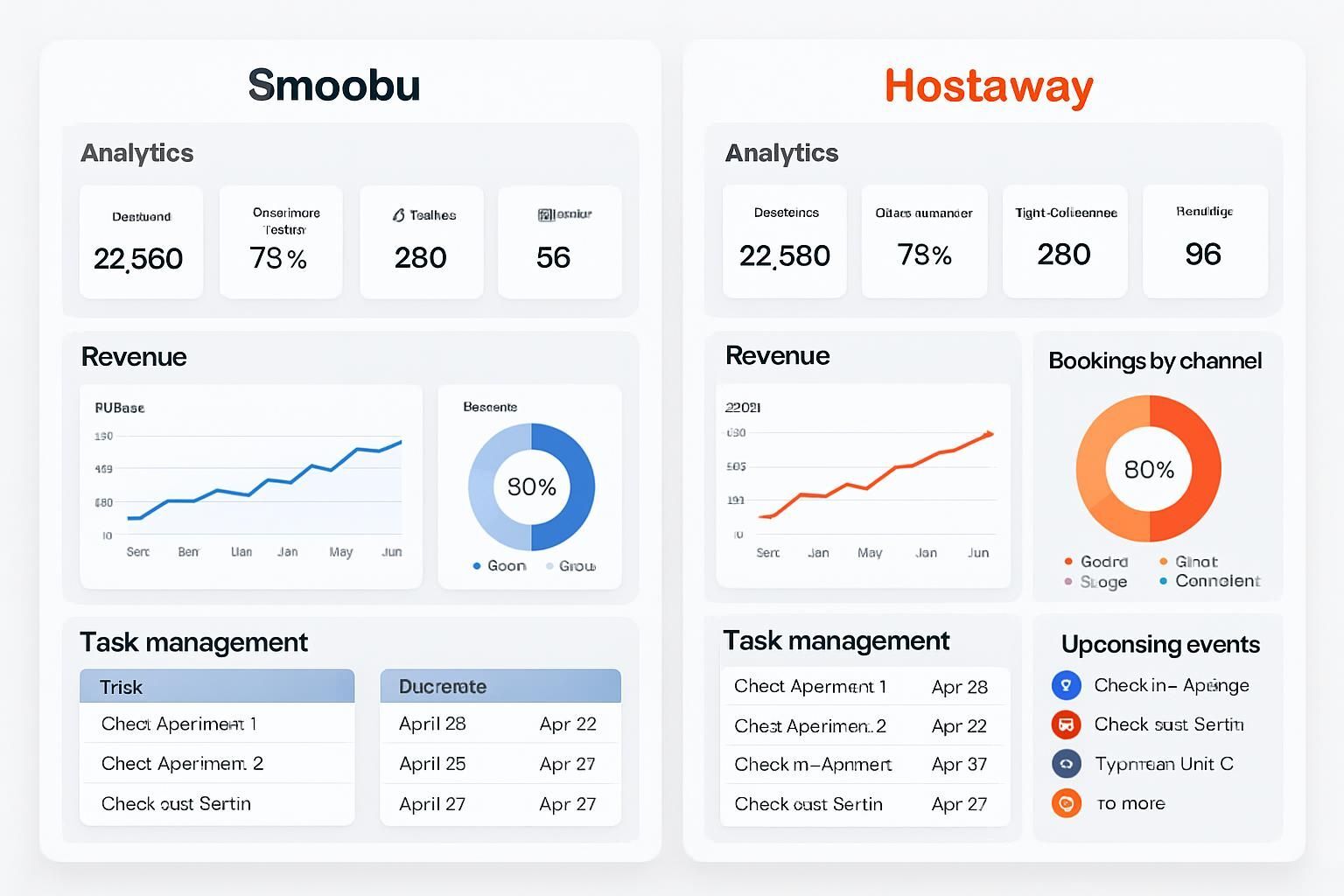
Automation and AI Capabilities in Hostaway and Smoobu Platforms
Automation transforms the vacation rental manager from a reactive coordinator to a proactive strategist. Technological advances in 2026 unlock new efficiencies—and both Hostaway and Smoobu wield automation as a cornerstone of their offering.
Hostaway’s Extensive Automation and AI-Powered Guest Communication
Hostaway invests deeply in automation: from auto-sending custom guest messages, chasing reviews, dispatching cleaning teams, to generating invoices and channel-specific reports. AI-powered guest communication bots can answer common guest inquiries—think check-in instructions or amenity disclosures—reducing host workload and ensuring consistent guest experience at all hours.
Extensive automation options are especially appreciated by portfolios spanning multiple time zones (e.g., agencies in Barcelona handling properties in Mexico City). Advanced rules and triggers surpass basic operational tasks, supporting sophisticated business models involving seasonal promotions and last-minute upselling. The only caveat, as noted in user reviews, is that configuring this system may require guidance from Hostaway specialists, particularly for automation-first hosts.
Smoobu’s Basic Automation Centered on Messaging and Booking Confirmations
Smoobu’s automation philosophy is pragmatic and focused. Automated guest messaging, booking confirmation emails, and calendar updates come pre-configured, sparing hosts the technical headaches of setup. This suitability for solo hosts or small teams is echoed in positive reviews highlighting simplicity: Jonas, the small-scale manager, recounts saving hours per week thanks to automatic guest scheduling and personalized welcome instructions.
Smoobu’s streamlined approach may not satisfy those seeking advanced, multi-layered automation—in which case Hostaway’s platform claims the upper hand. Yet, the reliability and accessibility of basic features eliminate a common pain point for independent managers juggling reservations, guest expectations, and property turnover.
Proprietary and Third-Party Tools: Reliability and Integration Balance
The collision between built-in reliability and integration flexibility emerges as a defining battleground between these two software titans.
Hostaway’s In-House Built Tools Ensuring Fast Support
Hostaway’s suite of proprietary tools underpins platform-wide consistency: bulk guest communication, unified analytics, and a built-in CRM are all made and maintained internally. Should a critical bug arise—like a payment gateway outage—updates can be deployed rapidly, without waiting for third-party providers. The result is lower downtime and expedited support, a boon for agencies acting on tight guest arrival windows.
However, Hostaway’s approach sometimes limits access to niche or region-specific integrations. Property managers with specialized needs—such as local legal compliance tools or market-specific dynamic pricing solutions—may find expansion constrained without significant customization efforts or workaround solutions.
Smoobu’s Hybrid Model of Built-In Features with External Integrations
Smoobu blends native tools and third-party integrations, striking a balance between stable core features and app store-style expandability. Through a well-developed API, hosts can connect Smoobu with accounting software, smart lock providers, or cleaning marketplaces. The hybrid model appeals to growing businesses who may want to test a new utility or respond to shifting guest trends (e.g., green energy monitoring or WhatsApp-based guest communication).
This strategy does involve vetting third parties for data security and compatibility—reviews occasionally highlight varying support quality depending on the integration partner. Nevertheless, Smoobu’s curated ecosystem and clear documentation reassure hosts navigating the evolving digital short-term rental world.
Platform | Smoobu | Hostaway |
|---|---|---|
Channel Management | API integration with 100+ portals, unlimited properties | Two-way sync, manual listing entry |
Dynamic Pricing | Transparent, monthly per property, 30-day free trial | Pay-per-listing, no trial, opaque pricing |
Support | Multilingual, responsive, live chat and webinars | Email/ticket-based, slower after-hours, no free trial |
Website Builder | Mobile-friendly, customizable, direct bookings | Limited customization, external domain config |
Automation | Guest messaging, confirmations | Advanced messaging, invoicing, AI guest comms |
Operational Tools for Cleaning and Maintenance Integration
Behind every glowing guest review stands a network of operational workflows—especially cleaning and maintenance—which can make or break the guest experience. Both Smoobu and Hostaway offer varying degrees of partner support and workflow integration.
Supported Partners and Workflow Efficiencies in Both Platforms
Smoobu allows direct connection with cleaning partners, either via its own integrations or through API, automating task assignments and status updates as new bookings populate the calendar. This is especially useful during high-turnover periods, such as local festivals in Barcelona or ski season in Zurich, where rapid cleaning cycles are non-negotiable.
Hostaway takes this a step further, integrating operational tools into its core PMS. Custom task triggers, auto-assigned jobs to maintenance teams, and in-system notifications streamline property care for large portfolios. Agencies managing dozens of units find they can cut operational costs and reduce workload coordination errors, as job progress is always visible within a unified dashboard. Reviews highlight improved staff satisfaction and guest ratings tied directly to seamless cleaning handoff.
Marketing and Direct Sales Support: Website SEO, Multilingualism, and Payment Options
Marketing edge and frictionless sales processes can mean the difference between full occupancy and empty calendars in today’s rental market. Smoobu and Hostaway bring different strengths to hosts eager to differentiate on SEO, language support, and payment gateways.
Smoobu’s Customization, SEO, and Payment Gateway Integration
Smoobu’s website builder isn’t just about aesthetics—it’s SEO-optimized out of the box, supports multiple languages, and connects effortlessly with major payment gateways. Property managers can highlight unique amenities, local experiences, and respond to guest expectations for direct bookings in any currency. Entry into the Asian, Latin American, or Middle Eastern markets is easier with native language support, often translating to improved conversion rates and increased guest trust.
A key advantage here is the end-to-end integration: site updates, booking engine, and pricing adjustments all flow through one platform, reducing errors and streamlining daily marketing work for hosts both large and small.
Hostaway’s Usability and Flexibility in Marketing Features
Hostaway facilitates integrated marketing tools, focusing on bulk guest messaging, coupon code promotions, and analytics tracking for email campaigns. Properties that harness seasonal offers or upsell packages—like late checkouts or local activity bundles—can trigger marketing automations directly from within the PMS. For established brands with steady direct traffic, these tools assure repeat business and higher lifetime guest value. Nevertheless, the absence of a tightly integrated website builder with embedded booking engine diminishes the seamless experience Smoobu offers, especially for smaller brands competing against monolithic platforms like Booking.com.
Reporting, Analytics, and Financial Management: Channel Revenue and Occupancy Insights
Actionable analytics have become the secret weapon for growing vacation rental businesses. Both Smoobu and Hostaway offer reporting frameworks, yet the depth and user experience diverge considerably.
Hostaway empowers property managers with comprehensive revenue tracking, customizable reports by channel and property, and automated financial statements integrating occupancy and performance data. Recognizable for supporting property corporations and fast-scaling agencies, Hostaway’s analytics give operators the granular data needed for strategic price adjustments, investment planning, and performance benchmarking. Advanced segmentation and exportability meet the needs of operators under pressure to deliver accountability to co-owners or investors.
Smoobu centers on simplicity—delivering visual occupancy charts, channel contribution overviews, and easy export of invoices and revenue by property or guest. Feedback from owner-operators highlights reliability without data overload; the actionable summaries suit those optimizing their seasonal offerings or checking channel balance in a few taps. For small agencies or busy multitaskers, this pragmatic approach delivers actionable insights without needing specialist staff to interpret results.
Onboarding, Training, and Help Resources: Ease of Adoption and Support Availability
Even the most sophisticated software falters if onboarding and training are overlooked. Here, Smoobu and Hostaway’s support philosophies shape the user journey from day one.
Hostaway’s Training Programs and Knowledge Base Access
Hostaway invests in structured training programs, tailored onboarding sessions, and a continually updated knowledge base. Larger operations benefit from dedicated account managers and scheduled webinars, helping teams transition legacy systems or upskill existing staff. The knowledge base enables self-service troubleshooting, while peer-led LinkedIn groups expand learning through community exchange. For advanced users, these resources make the most of Hostaway’s powerful—but complex—ecosystem.
Smoobu’s Webinars, Live Assistance, and User Assistance Resources
Smoobu delivers accessible learning via webinars, live chat, and a library of video tutorials—geared towards fast onboarding for solo hosts and small teams. Multilingual resources mean no operator is left behind, with exemplary feedback for the speed of response and practical clarity of “how-to” guides. Firsthand accounts of language-adjusted webinars and troubleshooting in real time present Smoobu as an ally for the globally diverse vacation rental community. The accessibility of these resources often turns first-time vacation rental entrepreneurs into raving advocates on social review platforms.
Objective Review Portal Insights: User Testimonials, Pain Points, and Advantages
Insights from user testimonial portals such as Capterra and Trustpilot often reveal realities that nonspecialist feature lists overlook.
Common Feedback Themes for Smoobu and Hostaway
Smoobu is regularly praised for its crystal clear pricing, rapid customer support, and ease of use—especially among independent hosts or regional agencies looking for simplicity and dependability. Negative reviews are typically linked to advanced feature limitations, especially regarding custom automation or reporting depth.
Hostaway’s fans spotlight the breadth of automation and sophisticated analytics, making it a darling of larger portfolio managers and agencies. However, pain points center on onboarding complexity, variable mobile app usability, and pricing transparency. These review trends are echoed in operator stories, online forums, and even cross-linked feedback across Facebook, Instagram, and LinkedIn.
Positive Experiences (Smoobu): Smooth onboarding, responsive support, no hidden fees, easy integrations.
Pain Points (Hostaway): Opaque pricing, longer training, advanced but complex automation setup.
This peer-driven landscape shapes which platform gains traction in distinct market segments, reinforcing the importance of real-world review evaluation before final investment.
Best Use Cases: Selecting Hostaway or Smoobu Based on Portfolio Size and Needs
The optimal vacation rental software is always context-driven—matching technology to ambitions, staff size, and market aspiration. The question remains: who should opt for Smoobu, and who for Hostaway?
Suitability for Individual Hosts and Small Portfolios
Smoobu emerges as the preferred choice for individual hosts and agencies handling a modest number of units (up to 20). Its clear pricing, out-of-the-box integrations, and rapid onboarding lower adoption barriers. For side-hustle property managers or lifestyle rental entrepreneurs, Smoobu’s simplicity, transparent value, and mobile app usability provide day-to-day autonomy and quick wins in a crowded market.
Examples include a solo host in Lisbon listing rooms on Airbnb and Booking.com or a regional player in Croatia venturing into the fast-growing direct bookings landscape—both can scale without overwhelming technical baggage.
Recommendations for Larger, Enterprise-Level Property Managers
Property managers overseeing 50, 100, or more listings benefit most from Hostaway’s advanced features. The platform’s automation, in-depth analytics, and support for complex integration make it a powerhouse for enterprise portfolios or franchises spanning cities—or even continents. Large property management companies can leverage Hostaway to unlock operational efficiencies, run sophisticated multichannel marketing, and automate nearly every aspect of guest interaction and property upkeep.
Yet, selecting Hostaway means committing to a steeper learning curve, the need for ongoing staff training, and negotiating customized pricing. For those with specialist teams and ambitions for rapid, large-scale scalability, these investments pay off as competitive advantages, ensuring they remain leaders in the dynamic vacation rental sector of 2026 and beyond.
Which platform offers a free trial for full feature access?
Smoobu provides a 14-day free trial without requiring a credit card, allowing full access to all features. Hostaway does not offer a free trial but instead schedules live demos for prospective clients.
How do Smoobu and Hostaway handle dynamic pricing for vacation rentals?
Smoobu delivers dynamic pricing with a transparent monthly per-property fee and a 30-day free trial, ideal for small to mid-sized portfolios. Hostaway requires per-listing payment, with pricing only revealed through direct negotiation, and lacks a free trial.
Can I build a customized direct booking website on both platforms?
Smoobu includes a mobile-friendly, customizable website builder supporting commission-free direct bookings and multi-language SEO. Hostaway’s website builder is more limited and lacks native domain management, requiring manual DNS adjustments.
Which software supports robust automation features for large agencies?
Hostaway best suits large property managers needing comprehensive automation—covering guest messaging, review reminders, billing, and AI-powered communications. Smoobu focuses on basic automation, ideal for owners who prefer simplicity and ease of setup.
How is overall customer support rated for each provider?
Smoobu receives accolades for quick, multilingual support via live chat, calls, or email, and is accessible to all levels of users. Hostaway’s support is ticket/email-based and praised for expertise in advanced scenarios but is marked as less responsive in urgent cases.