

From the allure of Airbnb Superhost prestige to the robust automation offered by platforms like Hospitable, vacation rental operators in 2026 face a wealth of tools and titles. Navigating these options means weighing the distinct advantages of personal reputation versus technology-driven management. Hospitable, Guesty, and Hostaway have reshaped how small operators and large-scale property managers run their businesses—streamlining guest messaging, synchronizing calendars across dozens of platforms, and unlocking smarter workflows. Yet, with Superhost status and enterprise solutions both driving booking confidence in unique ways, hosts must assess what delivers tangible value for their portfolio size, ambitions, and support needs.
Superhost is a recognition badge tied to individual host performance on Airbnb, while Hospitable and similar software platforms automate core property management operations.
Hospitable stands out for small-to-midsize portfolios thanks to its flat-rate pricing and intuitive automation tools focused on guest communication.
Guesty serves enterprise property managers with advanced features, a larger integration marketplace, and percentage-based pricing.
Hostaway’s scalable platform fits both growing hosts and multi-property managers, offering powerful integrations and flexible pricing.
Efficiency, booking rates, and guest satisfaction are shaped by a blend of reputation (e.g., Superhost) and operational excellence (driven by PMS software).
Comparison of Hospitable, Guesty, and Hostaway reveals that platform choice should align with portfolio complexity, growth plans, required automations, and support preferences.
Deep Dive into Airbnb Superhost Status: Eligibility, Benefits, and Performance Metrics
Understanding the Criteria and Quarterly Evaluation of Airbnb Superhosts
Achieving Airbnb Superhost status is a coveted milestone for many rental hosts, as it signals outstanding service and consistently high performance. To qualify, hosts must meet exacting criteria: a minimum of 4.8 overall rating, at least ten completed stays (or 100 nights over three stays), a cancellation rate below 1%, and a response rate of 90% or higher. Superhost status is reviewed every quarter, ensuring hosts sustain these impressive standards rather than resting on past laurels.
This regular assessment motivates hosts to maintain exceptional communication and reliability. As a result, achieving and maintaining Superhost can push hosts to refine their processes—streamlining cleaning schedules, guest follow-ups, and prompt communication to minimize the chance of a slip-in rating.
Significance of Being a Verified Listing Owner vs. Co-host or Experience Host
Airbnb’s Superhost badge is only awarded to those who own the listings—co-hosts and experience-only hosts are excluded from eligibility. This distinction underscores Airbnb’s focus on direct owner accountability and performance, tightening quality standards for guests. For example, a property manager co-hosting dozens of listings may not earn the badge, whereas an owner-host with hands-on care and personal investment in guest experience can achieve it.
This nuance shapes how property managers design their business model: those seeking the trusted glow of Superhost must align their management strategies and service delivery accordingly. It also places a ceiling on how widely the badge can scale across larger, team-driven portfolios.
How Superhost Recognition Enhances Guest Trust and Booking Rates
Superhost status boosts listing visibility, instills instant guest confidence, and often leads to higher booking conversion rates. When browsing, many travelers filter for these top-rated hosts, expecting greater responsiveness and fewer booking issues. Superhost hosts frequently see up to 22% higher bookings and improved review rates.
Guests, especially in highly competitive urban markets, report prioritizing Superhost properties for peace of mind. A single badge can be the deciding factor between two similar listings—demonstrating the tangible impact of this recognition in 2026’s travel landscape.
Practical Implications of Maintaining Superhost Status for Hosts
While the badge opens doors to extra exposure and trust, it also binds hosts to constant vigilance. Maintaining Superhost status often requires automating feedback requests, instant guest messaging, and swift problem resolution. Many hosts adopt hospitality software to help uphold these standards.
The pressure of quarterly audits can lead to burnout for owners managing high-volumes or those relying on manual systems. Herein lies the value of integrating operational software—closing the gap between personal service excellence and scalable business processes.
Hospitable Property Management Software: Features, Pricing, and Usability Overview
Core Functions of Hospitable for Small to Mid-Sized Vacation Rental Portfolios
Hospitable is designed for vacation rental owners and managers seeking to automate the routine, time-consuming tasks fundamental to hospitality. Its main features include automated guest communications, cross-platform calendar synchronization, and unified inbox for message management. For those managing anywhere from one to 30 properties, Hospitable enables a level of professionalism previously reserved for larger operators.
The software supports Airbnb, Booking.com, VRBO, and several other channels, making it simple to keep availability and bookings up to date everywhere. By consolidating inquiries and review management, Hospitable lets hosts focus on growing their business or giving personal touches to their guests.
Flat-rate Pricing and User-Friendly Interface: Strengths of Hospitable
One of Hospitable’s most attractive features is its transparent, flat-rate pricing, starting at a monthly fee untethered to bookings or revenue. This clarity appeals to individual hosts and those with moderate-sized portfolios wary of escalating costs. Its interface is intuitively designed, with streamlined dashboards and clear navigation.
Unlike some competitors requiring advanced onboarding or steep learning curves, Hospitable enables even tech-novices to automate messaging, set up scheduled tasks, and generate guest-ready responses in minutes. This accessibility lowers friction for hosts scaling from a single listing to a modest property collection.
Limitations of Hospitable’s Integration Marketplace Compared to Enterprise Solutions
Where Hospitable clearly diverges from enterprise platforms is in its integration marketplace. While effective at syncing calendars with major channels, its options for accounting, pricing engines, and smart home control are fewer than larger competitors. This means growing managers may hit functional ceilings unless supplementing with other apps or eventually migrating.
For context, Hostaway and Guesty support hundreds of direct integrations, catering to users needing advanced data analytics, owner portals, and dynamic pricing. Still, Hospitable’s pared-down approach is often an advantage for those prioritizing simplicity and cost control.
Automated Guest Communication and Calendar Syncing in Hospitable
Hospitable’s standout feature is its intelligent guest communication engine. Leveraging automation, the system sends routine reminders, post-booking instructions, and follow-ups instantly—cutting response times and reducing manual errors. Calendar syncing ensures that double bookings and availability confusion are virtually eliminated.
Many hosts cite the ability to maintain fast, friendly conversations (even while traveling or asleep) as the difference between retaining Superhost status and slipping below Airbnb’s thresholds. This direct link between software-driven efficiency and reputation is why platforms like Hospitable are indispensable for modern operators.
| Feature | Hospitable | Superhost | Guesty | Hostaway |
|---|
Comparative Analysis: Hospitable vs Airbnb Superhost and Other PM Software Platforms
Guesty’s Enterprise-Level Features and Percentage-Based Pricing Explained
Guesty is widely regarded as the enterprise gold standard in vacation rental software. Its suite of tools spans advanced reporting, owner portals, robust task management, and access to the largest marketplace of third-party integrations for dynamic pricing, cleaning apps, and payment processors. However, Guesty’s sophistication comes at a cost—typically a percentage of a host’s gross booking value.
Such a model works well for agencies or multi-location operators capable of leveraging bulk features and dedicated account management. But for solo hosts or those with 2–10 units, Guesty’s extensive toolkit may prove excessive and expensive relative to ROI.
How Hospitable Caters to Smaller Hosts with Streamlined Automation Tools
By contrast, Hospitable is purpose-built for those who value bright-line pricing and hands-off automation over complex functionality. Take the example of Jane, a host with five lakeside cabins: Hospitable relieves her of repetitive guest messaging, real-time booking updates, and review requests, all for a fixed monthly fee.
This makes it perfect for independent owners needing professional polish, but not the cumbersome layers required by large management firms.
Hostaway’s Scalability and Integration Marketplace for Growing Property Managers
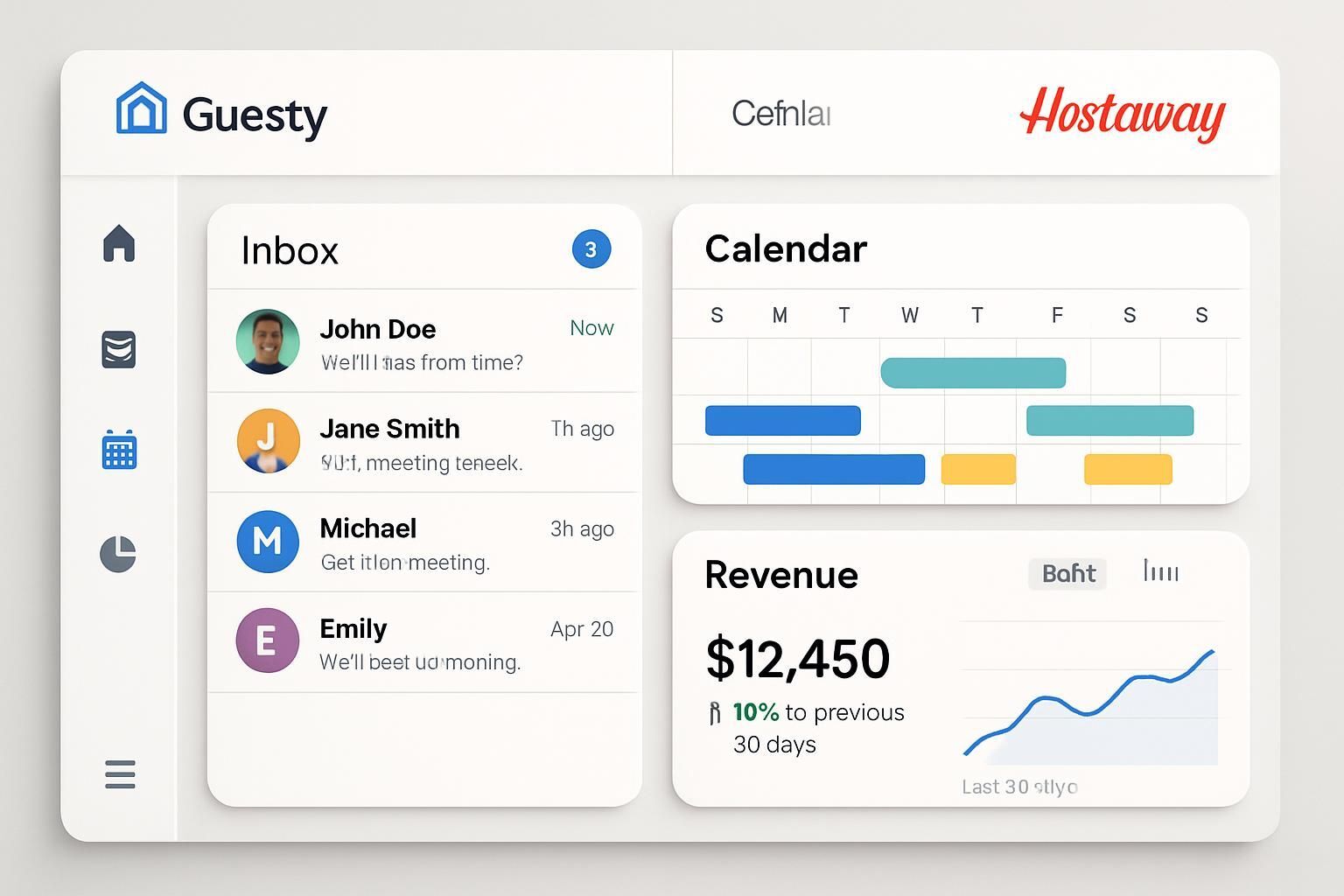
Hostaway sits between Hospitable and Guesty, targeting ambitious hosts who anticipate portfolio growth. Its platform is trusted by property managers running over 20 units, thanks to a vast integration marketplace—ranging from price optimization tools to smart lock solutions and cleaning schedules.
With scalable pricing and both self-serve and premium support options, Hostaway suits growth-oriented businesses. Feature highlights include: direct booking website builder, channel manager covering Airbnb, Booking.com, Expedia, and bulk reservation management that saves hours per week.
Matching Platform Choice to Business Size and Growth Ambitions
The distinctions between Hospitable, Guesty, and Hostaway reveal that fit trumps feature lists. Solo hosts and small portfolio owners are best served by simplicity and cost predictability. Agencies scaling nationwide or globally require deep integrations, multiple staff logins, and custom workflow automations—favoring Guesty or Hostaway.
In 2026, successful hosts follow their ambition: it’s not a question of which is best in general, but which best supports where you want your rental business to go.
Platform | Best For | Pricing Structure | Integrations | Guest Communication Automation | Direct Booking Website |
|---|---|---|---|---|---|
Hospitable | Small to mid-sized hosts | Flat monthly rate | Selective (core channels) | Robust, rule-based | Limited |
Guesty | Enterprise managers | Percentage-of-revenue | Extensive (hundreds) | Advanced, customizable | Yes |
Hostaway | Scaling property managers | Flexible, by portfolio size | Large integration marketplace | Strong, flexible | Yes, advanced |
Airbnb Superhost | Individual owners (recognition, not software) | Free (via performance) | N/A | Manual or with PMS | N/A |
Key Operational Features Impacting Vacation Rental Management Efficiency
Channel Management and Calendar Synchronization Across Platforms
Robust channel management empowers operators to publish, update, and sync listings across platforms like Airbnb, Booking.com, VRBO, and Expedia. Hostaway excels in this space, ensuring calendars update instantly, minimizing the risk of double bookings—a critical pain point for hosts scaling quickly.
In contrast, Hospitable supports efficient multi-channel syncing but with a lighter toolset, ideal for simple property mixes or early-stage growth. Here’s a concrete example: A host lists an apartment on multiple channels. Overbooking can mean refunds and a blow to rankings. Calendar syncing solves this headache, preserving reputation and cash flow.
Guest Communication Automation and Direct Booking Website Integration
Automated messaging is no longer a luxury—it’s a necessity. Platforms like Hospitable and Hostaway send triggered replies to guest inquiries, reminders pre- and post-check-in, and request for reviews. This consistency yields fewer missed reservations and a smoother guest journey.
Meanwhile, built-in website builders now let managers accept direct bookings, reducing fees and building their own brand. Hostaway and Guesty outpace Hospitable in this arena, supporting full customization, payment gateways, and integration with marketing tools—ideal for hosts keen to diversify away from reliance on third-party channels.
Customer Support Quality and Its Role in Host Experience and Retention
Customer support is the backbone of software adoption. Guesty offers 24/7 global support with dedicated account managers for large portfolios, keeping vital systems running even during peak travel seasons.
Hostaway provides a mix of live chat, scheduled calls, and community resources, matching the flexible needs of scaling property managers. In contrast, Hospitable’s email and chat-first approach is responsive for small users, but may feel lean to those running multi-location operations. The choice comes down to how much hand-holding a business requires.
Revenue Growth Potential Through Automation and Streamlined Operations
Reducing Manual Errors with Automated Task Management: Automated checklists, team task assignments, and instant status updates eliminate costly mistakes—lost time, unclean units, or overlooked maintenance. Hostaway and Guesty stand out for supervisors, while Hospitable hands smaller operators control over cleaning and turnover reminders.
Enhancing Guest Satisfaction via Consistent and Mobile Messaging: Smart replies to FAQs, personalized instructions, and clear communication—across time zones or languages—drive better reviews, higher occupancy, and more repeat bookings. In Jane’s case, Hospitable’s message automation kept her reviews at 4.95+ during her international travels.
Strategic Decision-Making: Selecting the Right Vacation Rental Software Platform
Advantages and Drawbacks: Hospitable, Guesty, and Hostaway Compared
No software is “one size fits all.” Hospitable shines for simplicity and affordability, yet falls short on advanced features and integrations needed by rapid-growth agencies. Guesty has near-limitless customization but at a cost and with complexity that can overwhelm modest operations. Hostaway bridges the gap—offering scalability, marketplace depth, and variable pricing, albeit with a steeper onboarding curve.
Successful hosts play to their strengths: for some, cost predictability trumps granular control; for others, integrated analytics and dedicated support are non-negotiable.
Evaluating Software Ecosystems: Third-Party Integrations and Direct Booking Benefits
A vibrant integration ecosystem multiplies the value of a core property management system. Hostaway and Guesty lead the way here, enabling hosts to add price optimizers like Beyond Pricing, housekeeping management such as Properly, and smart device controls in a few clicks.
Direct booking capabilities—like those offered by Hostaway—let branded operators escape the commission treadmill, empowering them to build loyalty and guest lists for re-engagement. This functionality is vital for ambitious brands wanting to build resilience against OTA dependency.
Importance of Support Services and Onboarding in Software Adoption
Adoption struggles are a primary reason hosts churn between platforms. Guesty’s tiered onboarding lets agencies deploy across teams with dedicated success managers. Hostaway offers both DIY and white-glove options, ensuring operators move at their pace. Hospitable wins on fast self-serve activation, but may lack the personalized support sought by larger teams.
Aligning Platform Choice with Long-Term Goals, Operational Complexity, and Budget
Ultimately, hosts should map platform selection to portfolio size, business ambition, and willingness to invest in learning or support. As properties, regulations, and guest expectations evolve beyond 2026, a forward-thinking approach—favoring scalability, robust integrations, and clear support channels—protects owners from costly migrations and operational headaches.
Smart hosts continually reevaluate their tech stack as they scale, ensuring their solution keeps pace with their growth—not the other way around.
How does Airbnb Superhost status impact my booking rate?
Superhost status on Airbnb boosts your listing’s visibility and guest trust, often resulting in increased booking conversion rates—sometimes by 20% or more, especially in competitive markets.
What is the difference between Hospitable and Guesty?
Hospitable prioritizes affordability, simplicity, and automation for small to mid-sized portfolios, while Guesty serves enterprise managers with advanced integrations, analytics, and percentage-based pricing.
Is Hostaway suitable for operators planning to scale?
Yes, Hostaway is built for scale, with a vast integration marketplace, flexible pricing, and robust channel management—ideal for growing vacation rental businesses.
Can property management software help me maintain Superhost status?
Yes. By automating guest communications, calendar management, and review requests, platforms like Hospitable and Hostaway help hosts meet Airbnb’s Superhost criteria consistently.
Does Hospitable offer a direct booking website feature?
Hospitable supports limited website building, but platforms like Hostaway and Guesty provide more advanced, customizable direct booking tools for host brands seeking to expand beyond OTAs.