
Between evolving regulatory landscapes and the ever-increasing guest expectations in the short-term rental market, property managers must leverage powerful, reliable technology platforms. Hostaway and iGMS have emerged as prominent choices for professionals who demand more than just basic booking tools—they require operational agility, focused automation, and data-driven insights. These platforms serve overlapping yet distinct slices of the industry. Hostaway appeals to those scaling sizable portfolios and seeking advanced features, while iGMS steers towards hosts who prioritize simplicity and essential automation.
Today’s property managers need robust, customizable dynamic pricing, seamless guest communication, and trusted integration with Airbnb, Booking.com, and Vrbo. Having a unified inbox, reliable synchronization, and clear financial reporting is non-negotiable—especially when scaling up. Meanwhile, direct booking capabilities and a spectrum of integrations increasingly differentiate top-tier platforms. As automation, scalability, and service quality become essential battlegrounds, choosing between Hostaway and iGMS can shape a management business’s future. Below, we explore the concrete differences, lived realities, and pivotal details that separate these two heavyweights of property management software.
At a glance
Hostaway suits medium to large property managers needing comprehensive, scalable tools and all-in-one automation—custom pricing based on portfolio size.
iGMS is ideal for smaller hosts emphasizing ease of use, affordability, and streamlined automation—features accessible with tiered per-booking pricing.
Hostaway offers a custom direct booking website, wide integrations (100+ apps), robust dynamic pricing, and advanced financial reporting.
iGMS provides core automated messaging, synchronized calendar, and focused connectors to Airbnb and Booking.com—perfect for small growth-focused portfolios.
Support models diverge: Hostaway brings 24/7 live help, while iGMS focuses on email/social support and accessible knowledge base.
Your choice hinges on portfolio size, desired automation complexity, budget, and long-term strategic ambitions.
Hostaway vs iGMS: Which Property Management Tool Reigns Supreme?
Hostaway vs iGMS: Core Software Differences for Short-Term Rental Management
Hostaway’s Market Positioning for Medium to Large Property Managers
Hostaway positions itself as a holistic operating system tailored for property managers who oversee medium to large portfolios across multiple channels, including Airbnb, Booking.com, and Vrbo. The platform is engineered to centralize complex workflows—melding multi-calendar management, advanced dynamic pricing, and deep automation with granular permissions for growing teams. Rapid scaling is facilitated by enterprise features: comprehensive task management, custom direct booking website tools, and in-depth financial reporting. These capabilities are geared toward maximizing occupancy, revenue, and operational efficiency. For a property manager like Emma, who scaled from a boutique set of city apartments to a diversified, 300-unit portfolio, the ability to fine-tune processes and delegate through sophisticated team management meant she could expand her offerings without sacrificing oversight or guest experience.
iGMS as an Automation-Focused Solution for Small to Mid-Sized Hosts
iGMS is designed for hosts managing a handful of units or a concentrated cluster, favoring an intuitive, easy-to-onboard experience over deep complexity. Its tools prioritize automation of repetitive tasks, notably through automated messaging, basic multi-calendar synchronization, and direct integration with large OTAs like Airbnb and Booking.com. Instead of the enterprise-grade customization of Hostaway, iGMS excels in simplicity—making it ideal for a self-managed landlord or small property manager who values reliability and budget predictability. Think of Lily, juggling five homes in suburban neighborhoods, who relies on iGMS to schedule cleaners, automate guest check-in communications, and keep booking calendars in sync, all without hiring external help or learning a complex new system.
Comparing Operational Tools: Unified Inbox and Multi-Calendar Features in Hostaway vs iGMS
The unified inbox is a centerpiece for guest communication. Hostaway delivers a feature-rich inbox supporting multi-channel conversations, automated responses, personalized templates, and direct escalation to team members. This means no dropped questions or double messages—even at scale. Meanwhile, iGMS presents a streamlined, intuitive universal inbox—best suited for hosts syncing messaging across Airbnb and Booking.com, with robust but less customizable options than Hostaway.
When it comes to the multi-calendar interface, both platforms provide real-time visibility into bookings and availability. Hostaway’s calendar, however, can handle portfolio-wide views with custom filters, assignment of task management, and channel synchronization at a granular level. iGMS focuses on essentials: maintaining real-time calendar updates and avoiding double bookings—perfect for small teams or solo operators with a tight focus on the essentials.
Task and Team Management: Scalability Implications in Hostaway and iGMS
Advanced task management is vital as a business grows. Hostaway stands out with its robust suite for team management, task delegation, and workflow tracking—allowing multiple users, role-specific controls, and performance dashboards. Teams can automate cleaning assignments after every check-out, coordinate repairs, and monitor who’s handling which property in real time. Conversely, iGMS delivers basic but instantly usable tools for solo hosts or small squads: automated reminders for cleaning, simplified scheduling, and easy status checks.
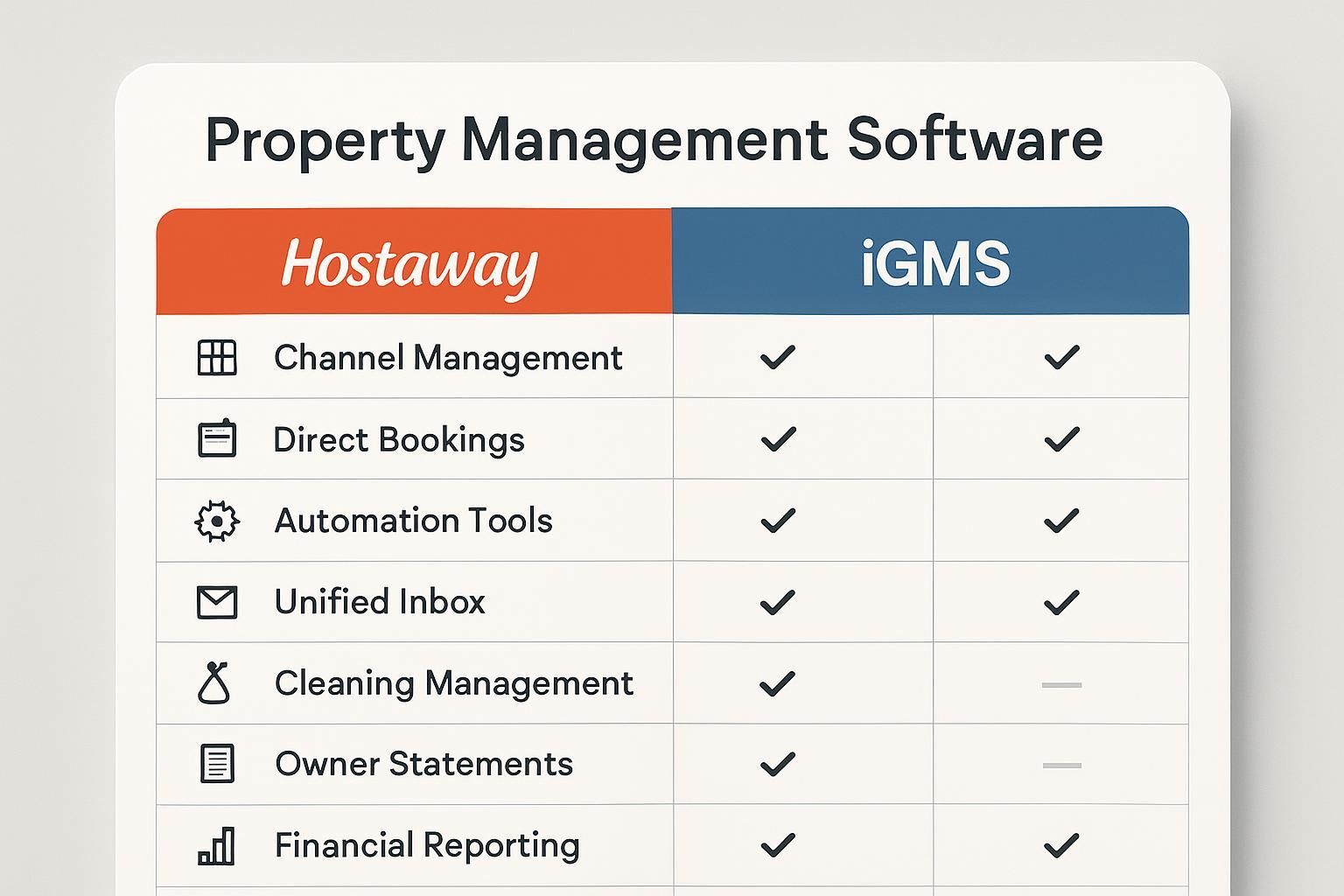
The flexibility and depth in Hostaway’s management tools empower operations with scale and complexity to run smoothly, whereas iGMS ensures smaller teams don’t get bogged down by unnecessary features, focusing instead on reliability and ease.
Feature Depth Comparison: Pricing, Reporting & Automation in Hostaway vs iGMS
Advanced Dynamic Pricing and Financial Reporting in Hostaway
Dynamic pricing and financial reporting distinguish Hostaway in the landscape of property management. Hostaway enables real-time automation of rates based on occupancy, local demand trends, seasonality, and more. Integrations with marketplaces and third-party pricing engines enable hosts to respond proactively to market shifts. Deep financial reporting modules help property managers produce detailed balance sheets, P&Ls, and tax-ready exports—critical for larger operators handling complex revenue streams across channels like Airbnb and Booking.com.
Case in point: A regional rental management company managing 200+ units leverages Hostaway to edge out competitors by optimizing nightly rates daily and producing transparent, accurate reports for its owners and investors.
Basic but Effective Automation and Reporting Tools in iGMS
iGMS covers fundamental needs: rule-based automated messaging, calendar syncing, and streamlined reporting summaries. Dynamic pricing tools are present but less customizable than Hostaway; most settings run on broader occupancy and seasonality triggers. Reporting is actionable for straightforward businesses—ideal for self-managed hosts reconciling income and expenses from a handful of properties. For many, this is ample: the automation of guest check-in instructions and cleaning notifications can save hours each week.
Impact of Feature Differences on Property Management Efficiency
The divergence in automation and reporting feature sets impacts real-world efficiency. Hostaway’s extensive automation means fewer manual interventions, with process chains that update bookings, trigger payment processing, and assign maintenance at scale. By contrast, iGMS suits a property manager seeking to keep their software simple; fewer menu options, but minimal likelihood of user error.
Hostaway’s Enhanced Automation for Large Portfolios
For hosts scaling past the 20-property mark, Hostaway’s automation arsenal means managers can deploy dynamic pricing, bulk messaging, and task automation—delegating much of the operational complexity to the software.
iGMS’s Streamlined Features for Smaller Hosts
iGMS targets hosts who want reliability and transparency. It speeds up daily communications, automates calendar sync, and provides clear reporting for hosts not looking to hire staff or handle intricate financial tracking.
Comparing Pricing Models: Hostaway Custom Pricing vs iGMS Tiered Per-Booking Fees
Hostaway’s Scalable Pricing Based on Property Count and Add-Ons
Hostaway adopts a custom pricing model: fees are typically calculated based on the number of properties under management, with optional add-ons for expanded features such as premium integrations, advanced automation, and direct booking websites. This structure appeals to agencies and managers with fluctuating portfolios who want pricing to scale with their business, but could pose budgetary challenges for small operators.
Hostaway | iGMS |
|---|---|
Custom pricing per property, extra for advanced integrations | Tiered monthly and per-booking pricing, budget-friendly entry |
Best for medium/large portfolios, flexible scaling costs | Ideal for small to mid-size hosts, costs predictable per booking |
iGMS’s Accessible Pricing for Small to Mid-Sized Operators
iGMS offers a transparent tiered pricing structure based on the number of listings and booking volume. Most small operators benefit from predictable fees, paying only for what they use—a key factor for part-time hosts or those testing the waters with a few properties on Airbnb or Booking.com at a time. While fewer customization options exist, the upfront cost structure keeps margins clear and surprises to a minimum.
Budget Considerations for Growing Rental Management Portfolios
Pricing strategies directly affect scaling. As a portfolio expands, Hostaway’s fee structure may net discounts or custom negotiations, crucial for professional managers handling numerous units across cities. For smaller hosts on iGMS, fixed booking fees grant straightforward budgeting, sidestepping large monthly commitments. Choosing between these often depends on a company’s ambitions and immediate operational realities.
Customer Support Comparison: Hostaway’s 24/7 Assistance vs iGMS’s Email and Social Media Support
Hostaway’s Live Support and Extensive Educational Resources
Hostaway offers round-the-clock customer support via phone, live chat, and tickets. In addition to real-time help, their online knowledge base, video tutorials, and webinars empower teams to train quickly and troubleshoot issues independently. This level of service ensures that, whether it’s payment processing confusion or calendar sync errors, support is never out of reach for managers running operations on weekends or holidays.
iGMS’s Email Support and Knowledge Base Accessibility
iGMS delivers dependable email and social media support, backed by an evolving knowledge base with guides and FAQs. Its community-driven approach suits independent hosts who prefer asynchronous solutions or social group advice. While real-time live chat is absent, many users value having their issues documented and responded to methodically.
Effect of Support Quality on User Onboarding and Continuous Use
The onboarding period is decisive: Hostaway’s comprehensive support expedites training for new team members and reduces downtime during critical periods. In contrast, iGMS’s knowledge base and email system make for a slower, but steady, introduction to essential features—fitting for solo hosts not under time pressure. As a rule, the quantity and immediacy of support must align with operational dependency on the software.

Scalability and Automation for Rental Business Growth: Hostaway vs iGMS
Hostaway’s Robust Scalability for Complex Operations
Hostaway’s feature richness, from payment processing to automation and reporting, delivers a scalable path for large, growing companies. Whether adding 10 or 100 new units, managers can replicate automation, view cross-portfolio reports, and grant granular access to multiple staffers without disrupting their workflows. This is essential for businesses with visions of national or even global expansion.
Essential Automation and Simplified Operations in iGMS
iGMS keeps growth manageable for small teams by focusing on essential automation. Quick property setups, accessible reporting, and intuitive calendar management enable hosts to handle more without straying into unnecessary complexity. For example, a part-time operator can expand from two to ten properties with minimal additional workload or learning curve.
Use Case Scenarios Highlighting Scalability Differences
A 50-property urban co-hosting operator chooses Hostaway, relying on bulk automation for dynamic pricing, workflow assignment, and deep reporting.
A family-run business with eight countryside cottages opts for iGMS, balancing affordability and automation without investing heavily in advanced integrations or custom onboarding.
Large Portfolio Management with Hostaway
For those managing more than 20–30 listings, Hostaway’s streamlined automation workflows and wide integrations mitigate manual errors, allowing for seamless onboarding of new units across regions or countries.
Small Host Operations Optimized by iGMS
Smaller operators avoid feature-bloat with iGMS, leveraging only essential automations to provide a personal touch, fast guest messaging, and hassle-free scheduling.
Direct Booking, Integrations, and Reliability: Navigating Hostaway vs iGMS Features
Hostaway’s Custom Booking Website Builder for Brand and Revenue Control
Hostaway elevates direct booking with an integrated website builder: property managers can launch tailored booking sites with branding elements, payment processing, and connections to external payment gateways. This supports marketing autonomy, enhanced guest loyalty, and reduced third-party commission fees—key for growing independent brands. Hostaway’s workflow enables seamless connection from property listing to guest payment confirmation.
iGMS’s Direct Booking Capabilities and Limitations
iGMS provides foundational direct booking functionality through shareable links or widgets. While practical for small hosts wanting to reduce reliance on Airbnb or Booking.com, these lack the depth and customization found in Hostaway. This can limit opportunities for direct guest acquisition and revenue building, though the simplicity appeals to hosts avoiding web development.
Comparing Third-Party App Integrations: Hostaway’s Extensive Ecosystem vs iGMS’s Focused Connectors
Hostaway distinguishes itself with its robust ecosystem, offering over 100 integrations—including dynamic pricing utilities, smart lock systems, accounting packages, and additional automation tools. This connectivity sets it apart for businesses that need flexibility and growth. By comparison, iGMS covers strategic ground—providing necessary links to Airbnb, Booking.com, and a selection of essential automations, but not the extended connectivity some larger professionals might require.
Operational Reliability: Synchronization and Automation Accuracy in Both Platforms
Operational reliability is paramount in short-term rental management. Hostaway excels with tight synchronization across channels, minimizing risks of double-booking or missed communications. Automated workflows and real-time updates ensure efficiency even as scale increases. iGMS delivers robust reliability for smaller contexts; automation routines are predictable, and synching functions for Airbnb and Booking.com are rock-solid. In both cases, correct configuration and adherence to recommended practices underpin success.
Comparaison des fonctionnalités : Hostaway vs. iGMS
Hostaway
- Custom website builder
- 100+ app integrations
- Advanced dynamic pricing
- 24/7 customer support
- Extensive automation & reporting
only differences
iGMS
- Easy onboarding
- Direct Airbnb & Booking.com integration
- Automated messaging essentials
- Tiered per-booking pricing
- Simplified reporting & team management
Which platform is better for large-scale property managers?
Hostaway is generally more suitable for medium to large property managers due to its advanced automation, dynamic pricing, reporting features, and scalable integrations.
Does iGMS support direct booking on my own website?
iGMS provides simple direct booking through shareable links and widgets, but does not offer a customizable website builder like Hostaway.
How does pricing differ between Hostaway and iGMS?
Hostaway uses custom pricing based on property count and selected add-ons, favoring large portfolios, while iGMS offers tiered, per-booking pricing that is accessible for small to mid-sized operators.
What kind of customer support can I expect from Hostaway and iGMS?
Hostaway provides 24/7 live customer support, extensive educational resources, and onboarding assistance. iGMS offers email and social media support along with a robust online knowledge base.
Can both Hostaway and iGMS be integrated with Airbnb, Booking.com, and Vrbo?
Yes, both platforms offer seamless integrations with Airbnb and Booking.com. Hostaway, however, supports a wider range of integrations, including Vrbo and over 100 more apps.